


100+ Synonyms of More With Examples and Explanations 2026
The word “more” means an additional amount, a greater number, or a higher degree of something. For example, when you ask for another cup of coffee, you might say, “I would like more coffee.” This simple word is common in everyday conversations, academic writing, professional communication, and online content.
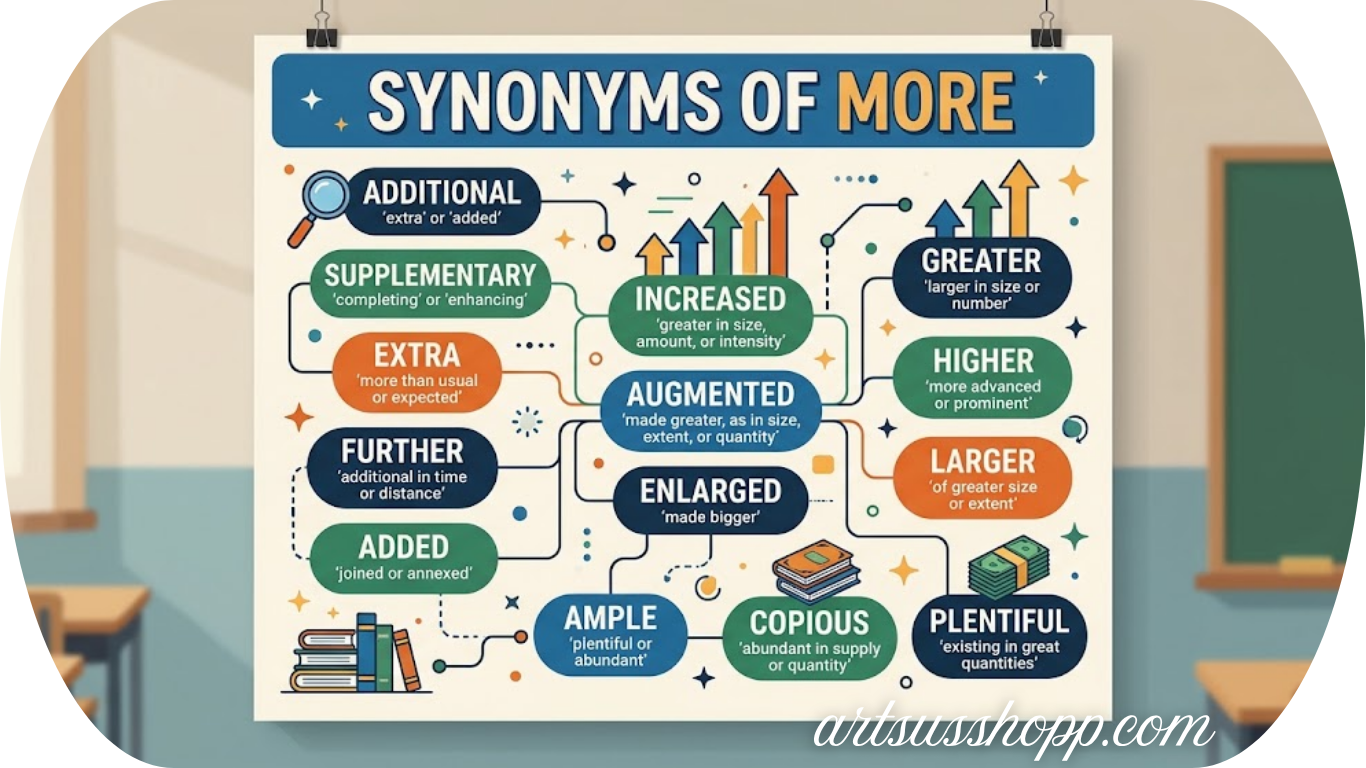
Although “more” is useful, repeating it too often can make writing sound less varied. Learning synonyms for more helps you express additional quantities, describe increases, compare things, and explain ideas more precisely. Depending on the context, you might use words such as additional, extra, further, greater, increased, or supplementary.
In this article, you will discover more than 100 synonyms and related expressions for more, along with their meanings, pronunciations, and examples. You will also learn the definition, grammatical uses, connotative meaning, word history, and differences between similar terms. These explanations will help you choose the right word for essays, professional documents, everyday conversations, and other forms of English writing.
Table of Contents
- Meaning of More
- Definition and Examples
- Connotative Meaning
- Etymology and History
- Pronunciation (US and UK IPA)
- Syllables
- Part of Speech
- Affixation Pattern and Word Formation
- 100+ Synonyms of More With Meanings and Examples
- Synonyms of More by Category
- Other Words for More in an Essay
- Difference Between More and Similar Words
- Prototype Meaning
- Prototype Categorization
- Antonyms of More
- Short Questions and Answers
- Conclusion
Meaning of More
Definition
More is a word that expresses an additional quantity, a greater number, or a higher degree of something. It can refer to physical objects, time, money, information, feelings, qualities, and actions.
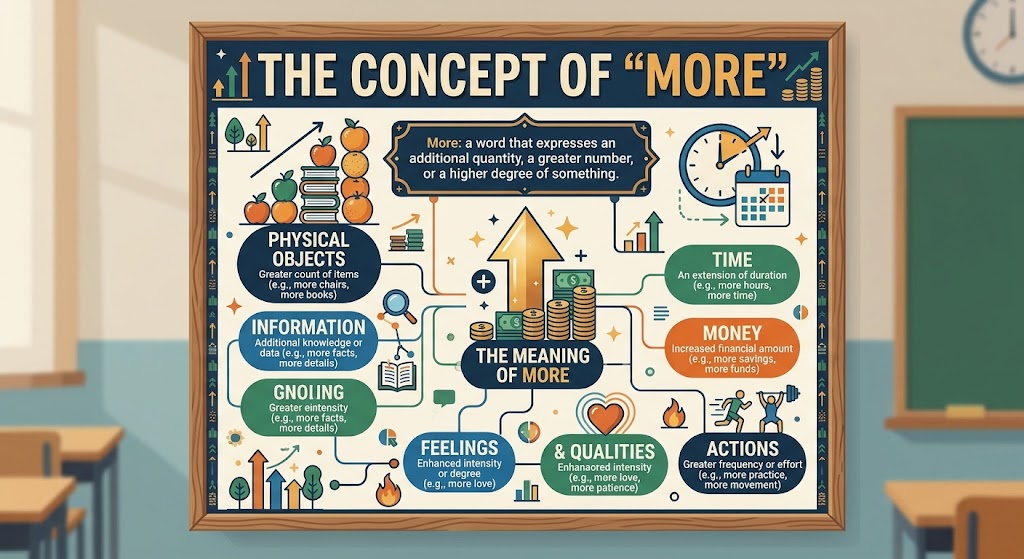
For example, if you have three books and receive two additional books, you have more books than before. Similarly, if you spend an extra hour studying, you spend more time on your education.
Examples:
- I need more time to complete the assignment.
- She wants more information about the course.
- The company hired more employees this year.
- We need more careful planning before making a decision.
- He enjoys reading more than watching television.
The meaning changes slightly depending on the sentence. In some cases, “more” refers to quantity. In others, it expresses comparison or a higher degree.
For example, “more water” means an additional amount of water, while “more interesting” means having a higher degree of interest.
Connotative Meaning of More
Connotation refers to the feelings, ideas, or associations a word may suggest beyond its basic definition.
The word “more” is generally neutral, but its meaning can feel positive or negative depending on the situation.
Positive Connotation
“More” can suggest growth, opportunity, improvement, or abundance.
Examples:
- More knowledge can help students make better decisions.
- The business needs more opportunities to grow.
- More practice can improve your writing skills.
In these sentences, the additional amount is presented as beneficial.
Negative Connotation
Sometimes, “more” suggests excess, pressure, waste, or an unwanted increase.
Examples:
- More expenses created financial difficulties.
- The employee was given more work than expected.
- More noise made it difficult to concentrate.
Here, the additional amount creates a problem rather than an advantage.
Neutral Connotation
In many sentences, “more” simply describes a difference in quantity or degree.
Examples:
- We need more chairs for the meeting.
- The second container holds more water.
- She requested more examples.
Understanding the context helps you decide whether a synonym such as “additional,” “excessive,” or “greater” communicates your intended meaning accurately.
Etymology and History of More
The word “more” has a long history in the English language.
Also Read: 100+ Synonyms of Furthermore: Meaning, Examples, and Formal Alternatives (2026)
It developed from Old English “māra,” which meant greater or larger. The word is related to older Germanic forms used to express comparison and increased quantity.
Over time, its spelling and pronunciation developed into the modern English form “more.”
A Brief History
- Old English: “Māra” expressed the idea of something being greater or larger.
- Middle English: The word developed into forms closer to the modern spelling “more.”
- Modern English: “More” became a common word for additional quantities, comparisons, and degrees.
Today, it appears in many everyday expressions, including “more information,” “more importantly,” “more or less,” and “once more.”
Pronunciation of More (US and UK IPA)
The word “more” is usually pronounced with one syllable.
- US English IPA: /mɔːr/
- UK English IPA: /mɔː/
Pronunciation varies by accent. In many American accents, the final r is pronounced. In most standard British accents, the final r is not pronounced unless followed by a vowel sound in connected speech.
Syllables
The word “more” has one syllable.
Syllable division: more
It is a short, single-syllable word that can be used before nouns, with adjectives, and in comparisons.
Part of Speech
The word “more” can serve several grammatical functions.
More as a Determiner
A determiner specifies the quantity of a noun.
Example: We need more chairs.
Here, “more” indicates an additional number of chairs.
More as a Pronoun
A pronoun can replace a noun or noun phrase when the meaning is understood.
Example: Would you like more?
The sentence does not specify the item because the context makes it clear.
More as an Adverb
An adverb can modify an adjective, another adverb, or a verb.
Examples:
- This explanation is more helpful.
- She works more efficiently now.
- I want to learn more.
In the first sentence, “more” modifies the adjective “helpful.” In the second, it modifies “efficiently.” In the third, it indicates an additional amount of learning or information.
Affixation Pattern of More
Affixation involves adding prefixes or suffixes to a word to create another form.
The word “more” does not normally take a productive prefix or suffix to create its standard comparative meaning.
- Root word: more
- Prefix: None in the ordinary comparative form
- Suffix: None in the ordinary comparative form
Related Word Forms
Several words are related to the meaning or use of “more,” but they are not all formed by attaching an affix directly to it.
- More: A greater amount or degree.
- Most: The greatest amount or degree in a comparison.
- Moreover: An adverb used to introduce an additional point.
- Moreish: An informal adjective, especially in British English, describing food or drink that makes you want to have more.
Examples:
- I need more time.
- She has the most experience.
- Moreover, the results support the proposal.
- The cookies were so moreish that everyone wanted another.
These words serve different grammatical purposes, so they should not be treated as interchangeable synonyms.
100+ Synonyms of More With Meanings and Examples
The following list contains useful alternatives for expressing additional quantity, greater degree, growth, expansion, and related meanings.
Not every word is a direct replacement for “more” in every sentence. Choose the synonym that matches the intended meaning and grammatical structure.
1. Additional (Adjective)
US IPA: /əˈdɪʃənəl/ | UK IPA: /əˈdɪʃənəl/
Meaning: Added to an existing amount or quantity.
Examples:
- We need additional chairs for the meeting.
- The teacher requested additional information.
2. Extra (Adjective)
US IPA: /ˈekstrə/ | UK IPA: /ˈekstrə/
Meaning: Beyond the usual amount or what is normally required.
Examples:
- I packed extra clothes for the trip.
- The students received extra time to finish the test.
3. Further (Adjective/Adverb)
US IPA: /ˈfɜːrðər/ | UK IPA: /ˈfɜːðə/
Meaning: Additional or extending beyond the current point.
Examples:
- We need further discussion before deciding.
- Further research may help explain the results.
4. Added (Adjective)
US IPA: /ˈædɪd/ | UK IPA: /ˈædɪd/
Meaning: Included as an additional part.
Examples:
- The package includes added benefits.
- The new plan provides added flexibility.
5. Increased (Adjective)
US IPA: /ɪnˈkriːst/ | UK IPA: /ɪnˈkriːst/
Meaning: Raised to a greater amount or level.
Examples:
- The company experienced increased demand.
- Increased funding helped the project succeed.
6. Greater (Adjective)
US IPA: /ˈɡreɪtər/ | UK IPA: /ˈɡreɪtə/
Meaning: Larger in amount, degree, or importance.
Examples:
- The project requires greater attention.
- She showed greater confidence during the interview.
7. Excess (Noun/Adjective)
US IPA: /ˈekˌses/ | UK IPA: /ɪkˈses/
Meaning: An amount beyond what is needed or considered appropriate.
Examples:
- The warehouse had excess inventory.
- Excess sugar can affect the taste of a recipe.
Note: “Excess” often suggests an amount beyond what is needed, so it is not suitable for every use of “more.”
8. Surplus (Noun/Adjective)
US IPA: /ˈsɜːrpləs/ | UK IPA: /ˈsɜːpləs/
Meaning: An amount remaining after needs have been met.
Examples:
- The farm produced a surplus of vegetables.
- The company sold its surplus equipment.
9. Spare (Adjective)
US IPA: /sper/ | UK IPA: /speə/
Meaning: Available for additional use.
Examples:
- Do you have a spare pen?
- We keep a spare key in a safe place.
10. Supplementary (Adjective)
US IPA: /ˌsʌpləˈmentəri/ | UK IPA: /ˌsʌplɪˈmentəri/
Meaning: Added to support or complete something.
Examples:
- The teacher provided supplementary reading materials.
- The report contains supplementary information.
11. Expanded (Adjective)
US IPA: /ɪkˈspændɪd/ | UK IPA: /ɪkˈspændɪd/
Meaning: Made larger, broader, or more extensive.
Examples:
- The company introduced an expanded product range.
- The revised guide includes an expanded discussion.
12. Broader (Adjective)
US IPA: /ˈbrɔːdər/ | UK IPA: /ˈbrɔːdə/
Meaning: Wider in scope or coverage.
Examples:
- We need a broader understanding of the problem.
- The campaign reached a broader audience.
13. Bigger (Adjective)
US IPA: /ˈbɪɡər/ | UK IPA: /ˈbɪɡə/
Meaning: Larger in physical size or, informally, amount.
Examples:
- They moved into a bigger house.
- The business needs a bigger budget.
14. Larger (Adjective)
US IPA: /ˈlɑːrdʒər/ | UK IPA: /ˈlɑːdʒə/
Meaning: Greater in size, quantity, or capacity.
Examples:
- We ordered a larger table.
- The city has a larger population than before.
15. Amplified (Adjective)
US IPA: /ˈæmplɪfaɪd/ | UK IPA: /ˈæmplɪfaɪd/
Meaning: Increased in strength, intensity, or effect.
Examples:
- The announcement amplified public interest.
- The sound was amplified through the speakers.
16. Enhanced (Adjective)
US IPA: /ɪnˈhænst/ | UK IPA: /ɪnˈhɑːnst/
Meaning: Improved or increased in quality, value, or effectiveness.
Examples:
- The update provides enhanced security.
- The new design offers enhanced functionality.
17. Elevated (Adjective)
US IPA: /ˈeləveɪtɪd/ | UK IPA: /ˈelɪveɪtɪd/
Meaning: Raised to a higher level.
Examples:
- The report identified elevated costs.
- The treatment may lead to elevated blood pressure.
18. Abundant (Adjective)
US IPA: /əˈbʌndənt/ | UK IPA: /əˈbʌndənt/
Meaning: Available in large quantities.
Examples:
- The region has abundant natural resources.
- Fresh produce is abundant during the summer.
19. Numerous (Adjective)
US IPA: /ˈnuːmərəs/ | UK IPA: /ˈnjuːmərəs/
Meaning: Existing in large numbers.
Examples:
- She received numerous invitations.
- Numerous studies have examined the topic.
20. Plenty (Noun/Pronoun)
US IPA: /ˈplenti/ | UK IPA: /ˈplenti/
Meaning: A large or sufficient amount.
Examples:
- We have plenty of time to prepare.
- There is plenty of food for everyone.
21. Excessive (Adjective)
US IPA: /ɪkˈsesɪv/ | UK IPA: /ɪkˈsesɪv/
Meaning: More than is reasonable, necessary, or desirable.
Examples:
- Excessive spending can create financial problems.
- The excessive noise disturbed the neighbors.
22. Overflowing (Adjective)
US IPA: /ˌoʊvərˈfloʊɪŋ/ | UK IPA: /ˌəʊvəˈfləʊɪŋ/
Meaning: Filled beyond capacity or present in very large amounts.
Examples:
- The overflowing basket was full of fruit.
- The room was overflowing with visitors.
23. Heavier (Adjective)
US IPA: /ˈhevɪər/ | UK IPA: /ˈheviə/
Meaning: Greater in weight or, in certain contexts, intensity or volume.
Examples:
- The workers carried a heavier load.
- Traffic became heavier during the evening rush.
24. Richer (Adjective)
US IPA: /ˈrɪtʃər/ | UK IPA: /ˈrɪtʃə/
Meaning: Fuller or more intense in flavor, quality, or content.
Examples:
- The sauce has a richer flavor.
- The revised story offers a richer description of the setting.
25. Multiplied (Verb/Adjective)
US IPA: /ˈmʌltɪplaɪd/ | UK IPA: /ˈmʌltɪplaɪd/
Meaning: Increased through multiplication or became many times greater.
Examples:
- The number of users multiplied within a year.
- The investment multiplied in value over time.
“Multiplied” is the correct spelling, not “multipled.”
26. Accumulated (Verb/Adjective)
US IPA: /əˈkjuːmjəˌleɪtɪd/ | UK IPA: /əˈkjuːmjəleɪtɪd/
Meaning: Gathered or collected gradually over time.
Examples:
- Dust accumulated on the shelves.
- She used her accumulated savings to start a business.
27. Countless (Adjective)
US IPA: /ˈkaʊntləs/ | UK IPA: /ˈkaʊntləs/
Meaning: So numerous that counting them is difficult or impractical.
Examples:
- The internet contains countless articles on the subject.
- They faced countless challenges during the project.
28. Extended (Adjective)
US IPA: /ɪkˈstendɪd/ | UK IPA: /ɪkˈstendɪd/
Meaning: Made longer in time, length, or scope.
Examples:
- The meeting continued for an extended period.
- The company offered an extended warranty.
29. Enlarged (Adjective)
US IPA: /ɪnˈlɑːrdʒd/ | UK IPA: /ɪnˈlɑːdʒd/
Meaning: Made larger in size or extent.
Examples:
- The photograph was enlarged for the display.
- The library now has an enlarged reading area.
30. Additional (Adjective)
US IPA: /əˈdɪʃənəl/ | UK IPA: /əˈdɪʃənəl/
Meaning: An amount or item added to what already exists.
Examples:
- Additional funding helped complete the project.
- The application requires additional documents.
This word is repeated here only to emphasize its importance as a general synonym; for a unique vocabulary list, count it once.
31. Supplement (Noun/Verb)
US IPA: /ˈsʌpləmənt/ (noun), /ˈsʌpləˌment/ (verb) | UK IPA: /ˈsʌplɪmənt/ (noun), /ˈsʌplɪˌment/ (verb)
Meaning: Something added to improve or complete an existing thing; or the act of adding to it.
Examples:
- The booklet is a supplement to the main textbook.
- The company hired temporary staff to supplement its regular team.
32. Incremental (Adjective)
US IPA: /ˌɪnkrəˈmentəl/ | UK IPA: /ˌɪŋkrɪˈmentəl/
Meaning: Increasing through small additions or stages.
Examples:
- The company achieved incremental growth.
- Incremental changes improved the website’s performance.
33. Substantial (Adjective)
US IPA: /səbˈstænʃəl/ | UK IPA: /səbˈstænʃəl/
Meaning: Large or significant in amount, size, or importance.
Examples:
- The project requires substantial investment.
- The new policy produced substantial savings.
34. Considerable (Adjective)
US IPA: /kənˈsɪdərəbəl/ | UK IPA: /kənˈsɪdərəbəl/
Meaning: Fairly large in amount, degree, or importance.
Examples:
- The renovation required considerable effort.
- The business experienced considerable growth.
35. Extensive (Adjective)
US IPA: /ɪkˈstensɪv/ | UK IPA: /ɪkˈstensɪv/
Meaning: Covering a large area, range, or amount of material.
Examples:
- The researchers conducted extensive testing.
- The library has an extensive collection of books.
36. Ample (Adjective)
US IPA: /ˈæmpəl/ | UK IPA: /ˈæmpəl/
Meaning: Enough or more than enough for a particular need.
Examples:
- We have ample time to prepare.
- The kitchen provides ample space for cooking.
37. Growing (Adjective)
US IPA: /ˈɡroʊɪŋ/ | UK IPA: /ˈɡrəʊɪŋ/
Meaning: Increasing in size, number, or importance.
Examples:
- The company serves a growing customer base.
- There is growing interest in renewable energy.
38. Rising (Adjective)
US IPA: /ˈraɪzɪŋ/ | UK IPA: /ˈraɪzɪŋ/
Meaning: Moving toward a higher amount, level, or position.
Examples:
- Rising prices affected household budgets.
- The organization responded to rising demand.
39. Boosted (Verb/Adjective)
US IPA: /ˈbuːstɪd/ | UK IPA: /ˈbuːstɪd/
Meaning: Increased, improved, or strengthened.
Examples:
- The campaign boosted sales.
- The new training program boosted employee confidence.
40. Augmented (Verb/Adjective)
US IPA: /ɔːɡˈmentɪd/ | UK IPA: /ɔːɡˈmentɪd/
Meaning: Increased or enhanced by adding something.
Examples:
- The team augmented its resources.
- The software uses augmented reality to display information.
41. Raised (Verb/Adjective)
US IPA: /reɪzd/ | UK IPA: /reɪzd/
Meaning: Increased to a higher amount or level.
Examples:
- The organization raised its fundraising target.
- The company raised employee salaries.
42. Higher (Adjective/Adverb)
US IPA: /ˈhaɪər/ | UK IPA: /ˈhaɪə/
Meaning: At a greater level, amount, or position.
Examples:
- The new plan has higher fees.
- The team achieved a higher score.
43. Expanded (Verb/Adjective)
US IPA: /ɪkˈspændɪd/ | UK IPA: /ɪkˈspændɪd/
Meaning: Increased in size, scope, or range.
Examples:
- The school expanded its course offerings.
- The expanded report includes new findings.
44. Extended (Verb/Adjective)
US IPA: /ɪkˈstendɪd/ | UK IPA: /ɪkˈstendɪd/
Meaning: Continued or made longer.
Examples:
- The manager extended the deadline.
- We enjoyed an extended vacation.
45. Widened (Verb/Adjective)
US IPA: /ˈwaɪdənd/ | UK IPA: /ˈwaɪdənd/
Meaning: Made broader or increased in scope.
Examples:
- The company widened its customer base.
- The research widened our understanding of the issue.
46. Broadened (Verb/Adjective)
US IPA: /ˈbrɔːdənd/ | UK IPA: /ˈbrɔːdənd/
Meaning: Expanded in range, scope, or understanding.
Examples:
- The course broadened her knowledge.
- The company broadened its product selection.
47. Amplified (Verb/Adjective)
US IPA: /ˈæmplɪfaɪd/ | UK IPA: /ˈæmplɪfaɪd/
Meaning: Made stronger or more noticeable.
Examples:
- The new evidence amplified public concern.
- The speaker’s voice was amplified.
48. Intensified (Verb/Adjective)
US IPA: /ɪnˈtensɪfaɪd/ | UK IPA: /ɪnˈtensɪfaɪd/
Meaning: Became stronger or more intense.
Examples:
- Competition intensified during the final round.
- The storm intensified overnight.
49. Magnified (Verb/Adjective)
US IPA: /ˈmæɡnɪfaɪd/ | UK IPA: /ˈmæɡnɪfaɪd/
Meaning: Made larger or caused to appear more significant.
Examples:
- The lens magnified the image.
- The media coverage magnified public interest.
50. Enriched (Verb/Adjective)
US IPA: /ɪnˈrɪtʃt/ | UK IPA: /ɪnˈrɪtʃt/
Meaning: Improved or made richer by adding something valuable.
Examples:
- The discussion enriched our understanding.
- The soil was enriched with nutrients.
51. Improved (Verb/Adjective)
US IPA: /ɪmˈpruːvd/ | UK IPA: /ɪmˈpruːvd/
Meaning: Made better in quality, condition, or performance.
Examples:
- The update improved the user experience.
- The team delivered improved results.
“Improved” refers to better quality, not necessarily a greater quantity, so use it only when improvement is intended.
52. Enhanced (Verb/Adjective)
US IPA: /ɪnˈhænst/ | UK IPA: /ɪnˈhɑːnst/
Meaning: Increased in quality, value, or effectiveness.
Examples:
- The software includes enhanced privacy controls.
- The redesign enhanced the appearance of the building.
53. Elevated (Verb/Adjective)
US IPA: /ˈeləveɪtɪd/ | UK IPA: /ˈelɪveɪtɪd/
Meaning: Raised to a higher position or level.
Examples:
- The change elevated the team’s performance.
- The report identified elevated demand.
54. Greater (Adjective)
US IPA: /ˈɡreɪtər/ | UK IPA: /ˈɡreɪtə/
Meaning: Larger or more important in degree or amount.
Examples:
- The new design offers greater flexibility.
- The decision requires greater care.
55. More Significant (Adjective Phrase)
Meaning: More important or having a greater effect.
Examples:
- The second result is more significant.
- The change had a more significant impact than expected.
56. More Important (Adjective Phrase)
Meaning: Having greater importance or priority.
Examples:
- Safety is more important than speed.
- The new evidence is more important to the investigation.
57. Crucial (Adjective)
US IPA: /ˈkruːʃəl/ | UK IPA: /ˈkruːʃəl/
Meaning: Extremely important to an outcome.
Examples:
- Clear communication is crucial to teamwork.
- Accurate measurements are crucial to the experiment.
58. Vital (Adjective)
US IPA: /ˈvaɪtəl/ | UK IPA: /ˈvaɪtəl/
Meaning: Extremely important or necessary.
Examples:
- Water is vital for life.
- Reliable information is vital to good decisions.
59. Paramount (Adjective)
US IPA: /ˈpærəmaʊnt/ | UK IPA: /ˈpærəmaʊnt/
Meaning: More important than anything else in a particular situation.
Examples:
- Customer safety is paramount.
- Accuracy remains paramount in scientific research.
60. Fundamental (Adjective)
US IPA: /ˌfʌndəˈmentəl/ | UK IPA: /ˌfʌndəˈmentəl/
Meaning: Basic or essential to something.
Examples:
- Trust is fundamental to strong relationships.
- Research is fundamental to the project.
61. Pivotal (Adjective)
US IPA: /ˈpɪvətəl/ | UK IPA: /ˈpɪvətəl/
Also Read:100+ Synonyms of Work: Meanings, Examples, and Better Word Choices (2026)
Meaning: Extremely important in determining an outcome.
Examples:
- The discovery played a pivotal role.
- Her advice was pivotal to the decision.
62. Essential (Adjective)
US IPA: /ɪˈsenʃəl/ | UK IPA: /ɪˈsenʃəl/
Meaning: Absolutely necessary or very important.
Examples:
- Practice is essential for improvement.
- Additional testing is essential before launch.
63. Indispensable (Adjective)
US IPA: /ˌɪndɪˈspensəbəl/ | UK IPA: /ˌɪndɪˈspensəbəl/
Meaning: So important that it cannot be done without.
Examples:
- Accurate records are indispensable.
- Teamwork is indispensable to the project.
64. Substantive (Adjective)
US IPA: /ˈsʌbstəntɪv/ | UK IPA: /ˈsʌbstəntɪv/
Meaning: Important in content or substance rather than merely appearance.
Examples:
- The revision introduced substantive changes.
- The committee discussed substantive concerns.
65. Meaningful (Adjective)
US IPA: /ˈmiːnɪŋfəl/ | UK IPA: /ˈmiːnɪŋfəl/
Meaning: Having real value, significance, or purpose.
Examples:
- The program produced meaningful improvements.
- The findings offer meaningful insight.
66. Furthermore (Adverb)
US IPA: /ˌfɜːrðərˈmɔːr/ | UK IPA: /ˌfɜːðəˈmɔː/
Meaning: In addition to what has already been stated.
Examples:
- The plan reduces costs. Furthermore, it improves efficiency.
- Furthermore, the study identifies several limitations.
67. Moreover (Adverb)
US IPA: /mɔːrˈoʊvər/ | UK IPA: /mɔːˈrəʊvə/
Meaning: In addition; used to introduce another supporting point.
Examples:
- The method is affordable. Moreover, it is reliable.
- Moreover, the findings support earlier research.
68. Additionally (Adverb)
US IPA: /əˈdɪʃənəli/ | UK IPA: /əˈdɪʃənəli/
Meaning: As another point or addition.
Examples:
- Additionally, the report includes updated figures.
- The course teaches writing. Additionally, it develops research skills.
69. In Addition (Transition Phrase)
Meaning: Used to introduce another item or point.
Examples:
- In addition, the company offers technical support.
- The report explains the costs. In addition, it describes possible savings.
70. Increasingly (Adverb)
US IPA: /ɪnˈkriːsɪŋli/ | UK IPA: /ɪnˈkriːsɪŋli/
Meaning: To a growing degree or more frequently over time.
Examples:
- Students are increasingly using digital resources.
- Businesses are increasingly focusing on customer experience.
71. Further Information (Noun Phrase)
Meaning: Additional facts or details about a subject.
Examples:
- Please contact the office for further information.
- The website provides further information about the course.
72. Additional Details (Noun Phrase)
Meaning: Extra facts that explain something more precisely.
Examples:
- The manager requested additional details.
- The document contains additional details about the process.
73. Further Evidence (Noun Phrase)
Meaning: More information that supports a claim or conclusion.
Examples:
- Further evidence is needed to confirm the result.
- The investigators collected further evidence.
74. Additional Research (Noun Phrase)
Meaning: More investigation into a topic.
Examples:
- Additional research may clarify the findings.
- The subject requires additional research.
75. Further Analysis (Noun Phrase)
Meaning: More detailed examination of information.
Examples:
- Further analysis revealed a pattern.
- The results require further analysis.
76. A Lot More (Phrase)
Meaning: A considerably greater amount; informal.
Examples:
- The updated version offers a lot more flexibility.
- We need a lot more time to finish.
77. Much More (Phrase)
Meaning: A substantially greater amount or degree.
Examples:
- This approach is much more efficient.
- The second option is much more affordable.
78. Far More (Phrase)
Meaning: Considerably more than something else.
Examples:
- The revised system is far more reliable.
- This method requires far more preparation.
79. Considerably More (Phrase)
Meaning: A noticeably or substantially greater amount.
Examples:
- The project needs considerably more funding.
- The new process is considerably more efficient.
80. Substantially More (Phrase)
Meaning: A large additional amount or degree.
Examples:
- The second phase requires substantially more time.
- The updated system uses substantially more storage.
81. Significantly More (Phrase)
Meaning: More by a noticeable or important amount.
Examples:
- The new version offers significantly more features.
- The second group received significantly more funding.
82. Even More (Phrase)
Meaning: An amount or degree greater than what was already mentioned.
Examples:
- The discovery made the subject even more interesting.
- We need even more evidence before reaching a conclusion.
83. Still More (Phrase)
Meaning: An additional amount beyond what has already been mentioned.
Examples:
- Still more questions arose during the discussion.
- The investigation uncovered still more details.
84. Many More (Phrase)
Meaning: A larger number of countable people or things.
Examples:
- Many more students applied this year.
- The store expects many more customers during the holidays.
85. A Great Deal More (Phrase)
Meaning: A considerably greater amount.
Examples:
- We need a great deal more information.
- The project requires a great deal more effort.
86. Plenty More (Phrase)
Meaning: A large additional amount.
Examples:
- There is plenty more to learn.
- We have plenty more supplies available.
87. A Growing Number of (Phrase)
Meaning: An increasing number of people or things.
Examples:
- A growing number of businesses use online payment systems.
- A growing number of students prefer digital textbooks.
88. Greater Quantity (Noun Phrase)
Meaning: A larger amount of something.
Examples:
- The recipe requires a greater quantity of flour.
- The second container holds a greater quantity of water.
89. Higher Amount (Noun Phrase)
Meaning: A larger numerical amount or value.
Examples:
- The customer paid a higher amount than expected.
- The revised budget includes a higher amount for training.
90. Increased Volume (Noun Phrase)
Meaning: A greater quantity, capacity, or level of output.
Examples:
- The factory handles an increased volume of orders.
- The website experienced an increased volume of traffic.
91. Expanded Range (Noun Phrase)
Meaning: A wider variety of choices or offerings.
Examples:
- The store introduced an expanded range of products.
- The course provides an expanded range of learning materials.
92. Greater Variety (Noun Phrase)
Meaning: A larger selection of different types.
Examples:
- The restaurant offers greater variety.
- The updated collection provides greater variety for customers.
93. Additional Resources (Noun Phrase)
Meaning: Extra materials, funds, people, or tools.
Examples:
- The school needs additional resources.
- The team received additional resources for the project.
94. Further Opportunities (Noun Phrase)
Meaning: Additional chances to do something or make progress.
Examples:
- The program creates further opportunities for students.
- The new partnership may provide further opportunities.
95. Increased Capacity (Noun Phrase)
Meaning: A greater ability to hold, produce, or handle something.
Examples:
- The upgrade provides increased capacity.
- The new facility has increased capacity for visitors.
96. Greater Depth (Noun Phrase)
Meaning: More detail, complexity, or understanding.
Examples:
- The revised article provides greater depth.
- The course explores the topic with greater depth.
97. Additional Benefits (Noun Phrase)
Meaning: Extra advantages or positive outcomes.
Examples:
- The membership includes additional benefits.
- The new policy offers additional benefits to employees.
98. Further Progress (Noun Phrase)
Meaning: Additional development or movement toward a goal.
Examples:
- The team made further progress.
- Further progress depends on consistent practice.
99. Greater Emphasis (Noun Phrase)
Meaning: Increased attention or importance given to something.
Examples:
- The new policy places greater emphasis on safety.
- The course places greater emphasis on practical skills.
100. Additional Support (Noun Phrase)
Meaning: Extra help, assistance, or resources.
Examples:
- Students can request additional support.
- The project needs additional support to meet its deadline.
101. Additional Opportunities (Noun Phrase)
Meaning: Extra chances to participate, learn, or succeed.
Examples:
- The internship provides additional opportunities to gain experience.
- The organization created additional opportunities for training.
102. Greater Extent (Noun Phrase)
Meaning: A higher degree or wider scope.
Examples:
- The new method was successful to a greater extent.
- The policy applies to a greater extent than before.
103. Beyond That (Transition Phrase)
Meaning: In addition to a point already mentioned.
Examples:
- The course teaches basic skills. Beyond that, it develops independent thinking.
- Beyond that, the proposal addresses long-term planning.
104. Over and Above (Phrase)
Meaning: In addition to something already included or expected.
Examples:
- Employees received benefits over and above their salaries.
- The grant covered costs over and above the original budget.
105. More Than Sufficient (Phrase)
Meaning: Enough to meet a need, with some amount remaining.
Examples:
- We have more than sufficient time to prepare.
- The available evidence is more than sufficient for this basic conclusion.
Synonyms of More by Category
Choosing the best synonym becomes easier when words are grouped by their intended meaning.
Words for More Quantity
Use these when you mean a greater amount or an additional item:
- Additional
- Extra
- Added
- Further
- Another
- Spare
- Surplus
- Supplementary
- Plenty
- Greater quantity
Example: We need additional supplies before the event.
Words for More Important
Use these when you want to emphasize priority or significance:
- Crucial
- Vital
- Paramount
- Essential
- Pivotal
- Indispensable
- Significant
- Fundamental
- Consequential
- Of greater importance
Example: Accurate information is essential to the decision.
Words for More Information
Use these when asking for details, evidence, or explanation:
- Further information
- Additional details
- Further evidence
- Additional research
- Further analysis
- Expanded explanation
- Greater insight
- Additional documentation
- Supporting material
- Further clarification
Example: Please provide further information about the application.
Words for Much More
Use these to emphasize a substantial difference:
- Far more
- Much greater
- Considerably more
- Substantially more
- Significantly more
- A great deal more
- A lot more
- Even more
- Still more
- A whole lot more
Example: The revised process is considerably more efficient.
Words for More in Academic Writing
Use these expressions when adding arguments or describing further investigation:
- Furthermore
- Moreover
- Additionally
- In addition
- Further research
- Additional evidence
- Further analysis
- Greater emphasis
- In greater detail
- To a greater extent
Example: Furthermore, the results indicate a need for additional research.
Other Words for More in an Essay
In an essay, the best alternative depends on the sentence’s purpose. Some expressions introduce new information, while others describe a greater degree or stronger importance.
Example 1: Adding Information
Original: The program helps students learn. More, it improves their confidence.
Improved: The program helps students learn. Furthermore, it improves their confidence.
“Furthermore” is a suitable transition because it introduces another supporting point.
Example 2: Describing a Greater Amount
Original: The study needs more evidence.
Improved: The study needs additional evidence.
“Additional” makes it clear that more supporting information is required.
Example 3: Emphasizing Importance
Original: More importantly, the policy protects vulnerable people.
Alternative: Of greater importance, the policy protects vulnerable people.
Another natural option is “More significantly,” depending on the intended meaning.
Example 4: Explaining an Idea
Original: The author explains the subject more fully.
Improved: The author explains the subject in greater detail.
The revised sentence specifies how the explanation is improved.
Example 5: Describing a Difference
Original: The new method is more effective than the old one.
Improved: The new method is considerably more effective than the old one.
Use the revised version when the difference is substantial and the available evidence supports that description.
Difference Between More and Similar Words
Although several words are related to “more,” they do not all express the same idea.
| Word | Main meaning | Example |
| More | An additional amount or greater degree | We need more time. |
| Additional | Added to what already exists | We need additional time. |
| Extra | Beyond what is normally needed | We brought extra supplies. |
| Further | Additional or continuing | Further research is needed. |
| Greater | Larger in amount, degree, or importance | The project requires greater care. |
| Increased | Raised above an earlier level | Increased demand affected prices. |
| Surplus | More than is needed | The store sold its surplus stock. |
| Excessive | More than is reasonable or desirable | Excessive spending caused problems. |
| Numerous | Many in number | Numerous people attended. |
| Abundant | Available in large quantities | The region has abundant resources. |
More vs. Additional
“More” is general and works in many situations. “Additional” usually emphasizes something being added to an existing amount.
- More chairs are needed.
- Additional chairs are needed.
Both sentences are correct, but “additional chairs” can sound more formal.
More vs. Extra
“Extra” often refers to something beyond the normal requirement.
- I need more time.
- I need extra time.
Both can be correct. “Extra time” often suggests an extension beyond the original allowance.
More vs. Further
“Further” is common when talking about progress, investigation, or additional discussion.
- We need more information.
- We need further information.
Both are natural, although “further information” is often preferred in formal communication.
More vs. Greater
“Greater” usually describes a comparison of amount, degree, or importance.
- We need more care.
- We need greater care.
The second sentence emphasizes a higher level of care.
More vs. Excessive
“More” is generally neutral, while “excessive” means too much.
- The machine requires more power.
- The machine consumes excessive power.
The first sentence simply describes an additional requirement. The second suggests that the amount of power is unreasonably high.
Prototype Meaning of More
A prototype meaning is the most typical or familiar meaning people associate with a word.
For “more,” the central idea is an increase in quantity or degree.
For example, imagine a person with two apples who receives three additional apples. The person now has more apples.
Other familiar examples include:
- More time to complete a task.
- More money to cover expenses.
- More information to understand a subject.
- More practice to improve a skill.
- More space to store belongings.
These examples share the idea of an additional amount or a greater level.
Prototype Categorization of More
The word “more” can be grouped into several categories according to its meaning.
Additional Quantity
This category refers to extra items or amounts.
Examples: additional, extra, added, supplementary, spare.
Growth and Increase
This category describes something becoming larger or rising in level.
Examples: increased, growing, rising, expanded, augmented.
Large Amount
This category emphasizes a considerable quantity or number.
Examples: abundant, numerous, plenty, countless, extensive.
Greater Degree
This category expresses a stronger quality, level, or comparison.
Examples: greater, higher, considerably more, substantially more, far more.
Further Information
This category focuses on extra explanation, evidence, or investigation.
Examples: additional details, further evidence, further analysis, additional research.
Added Importance
This category describes something that deserves greater attention.
Examples: crucial, vital, paramount, essential, pivotal.
Grouping synonyms this way helps writers choose words that match the intended meaning rather than selecting alternatives randomly.
Antonyms of More
An antonym is a word with an opposite or contrasting meaning.
The most common antonyms of “more” include “less” and “fewer.” Other alternatives may apply when discussing reductions, limitations, or shortages.
1. Less
Meaning: A smaller amount or degree.
Example: We need less sugar in the recipe.
2. Fewer
Meaning: A smaller number of countable items.
Example: Fewer students attended the meeting.
3. Reduced
Meaning: Made smaller or lower.
Example: The company announced reduced prices.
Also Read:100+ Synonyms of Warm: Meaning, Examples, and Different Words for Warm (2026)
4. Decreased
Meaning: Became smaller in amount, level, or intensity.
Example: Demand decreased during the winter.
5. Lower
Meaning: At a smaller level or value.
Example: The revised plan has lower costs.
6. Limited
Meaning: Restricted in amount or availability.
Example: The service offers limited storage.
7. Scarce
Meaning: Available in insufficient quantities or difficult to obtain.
Example: Clean water became scarce during the drought.
8. Minimal
Meaning: Very small in amount or degree.
Example: The change had minimal impact.
9. Diminished
Meaning: Reduced in strength, size, or importance.
Example: Public interest diminished over time.
10. Smaller
Meaning: Less in size or quantity.
Example: We ordered a smaller amount of material.
Remember that “less” usually applies to uncountable quantities, while “fewer” generally applies to countable items.
For example, “less water” and “fewer bottles” are standard choices.
Short Questions and Answers
What does more mean?
“More” means an additional amount, a greater number, or a higher degree of something. It is commonly used for quantity, comparison, and degree.
What is another word for more?
Common alternatives include additional, extra, further, greater, increased, and supplementary. The best choice depends on the sentence.
What is a formal synonym for more?
“Additional,” “further,” “supplementary,” and “substantial” can be suitable in formal writing when their meanings fit the context.
What are other words for more in an essay?
Useful alternatives include “furthermore,” “moreover,” “additionally,” “in addition,” “further evidence,” and “to a greater extent.”
What is another word for more important?
Depending on the sentence, alternatives include “more significant,” “more critical,” “vital,” “crucial,” “paramount,” and “of greater importance.”
What is the difference between more and most?
“More” usually expresses a greater amount or degree, while “most” commonly identifies the greatest amount or degree in a group.
Example: She has more experience than I do. She has the most experience on the team.
Is more a positive or negative word?
“More” is generally neutral. It can suggest a benefit, such as more knowledge, or a problem, such as more expenses. The context determines its effect.
What is the opposite of more?
The most common opposite is “less.” Use “fewer” when referring to a smaller number of countable items.
Conclusion
Learning synonyms of more can help you express quantity, comparison, growth, and additional information with greater precision. Words such as additional, extra, further, greater, increased, and supplementary are useful alternatives, but their meanings differ according to context.
For essays and professional writing, expressions such as “furthermore,” “moreover,” “additional evidence,” and “to a greater extent” can improve transitions and make explanations clearer. When discussing importance, words such as “crucial,” “vital,” and “paramount” may be appropriate if the intended meaning supports them.
The goal is not to replace every instance of “more.” Instead, choose a word that fits the sentence, preserves its meaning, and sounds natural to the reader. Practicing these alternatives will help you build a stronger vocabulary and communicate more effectively in everyday English, academic assignments, and professional documents.


Pingback: 100+ Synonyms of Thing with Examples and Explanations 2026 - artsusshop .com/