



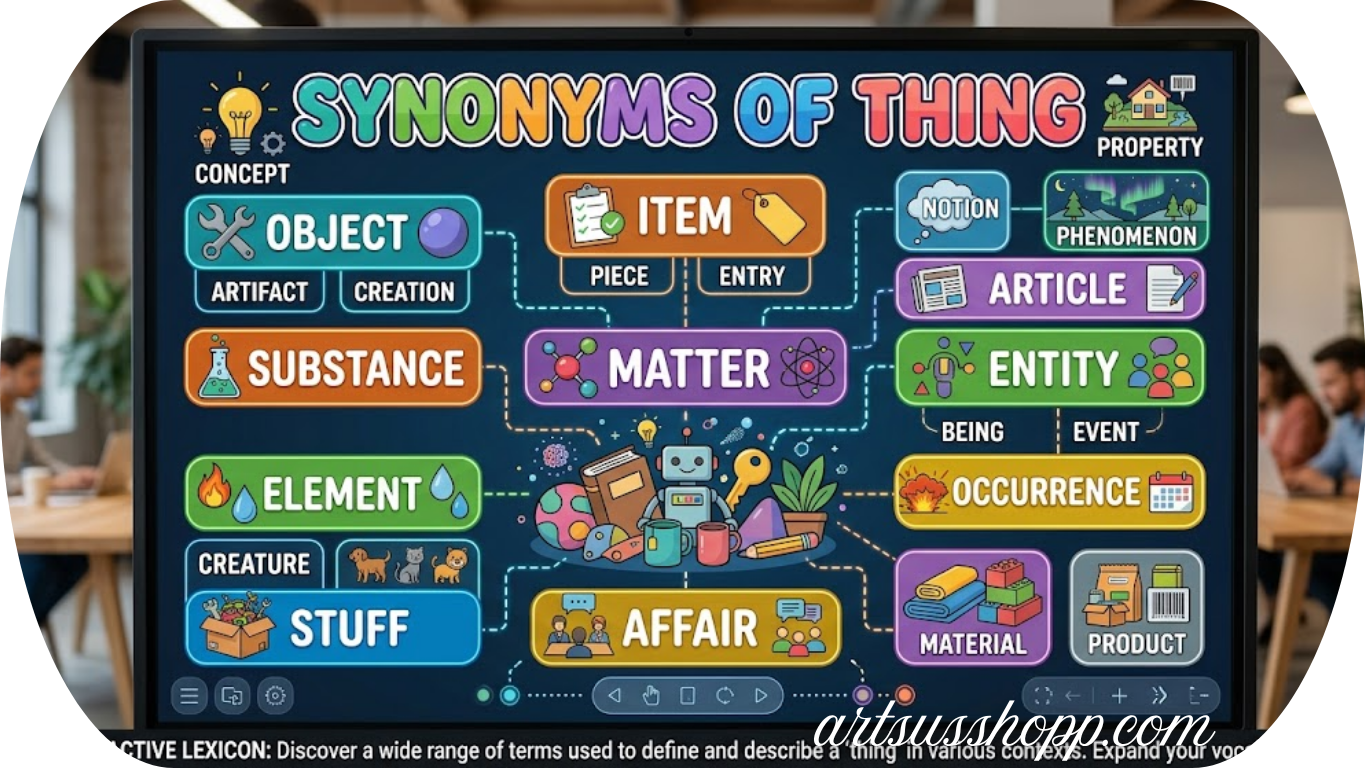
100+ Synonyms of Thing with Examples and Explanations 2026
The word “thing” is one of the most commonly used words in English. It can describe an object, idea, situation, activity, event, or subject that someone wants to mention without giving it a specific name. For example, a person might say, “There is one thing I need to tell you.” The word makes the sentence simple, but using it repeatedly can make writing less precise.
Learning synonyms for thing helps you express ideas more clearly in everyday conversations, essays, professional emails, and academic writing. Depending on the context, alternatives such as object, item, matter, issue, concept, aspect, and element may communicate your meaning more effectively.
This guide explains more than 100 useful synonyms and related alternatives for thing and things. Each entry includes a meaning and example to help you understand how the word works in a sentence.
Meaning of Thing
The word “thing” is a general noun that refers to an object, idea, event, situation, or anything being discussed or considered. Its exact meaning depends on the context in which it appears.
For example, in “Put that thing on the table,” the word refers to a physical object. In “The important thing is to remain calm,” it refers to a point or consideration. In “We have many things to do,” it refers to activities or tasks.
Because the word has such a broad meaning, no single synonym can replace it in every sentence. The most appropriate alternative depends on whether you are describing an object, idea, problem, experience, or activity.
Definition of Thing
According to its general English usage, a thing is an object, entity, matter, event, or idea that can be identified, discussed, experienced, or considered.
The word is particularly useful when the speaker does not know an object’s exact name or does not need to identify it precisely. However, when the meaning is clear, using a more specific noun can make communication more effective.
Examples:
- “I bought a new thing for my room.” Here, thing refers to an unspecified object.
- “One thing I learned was patience.” Here, thing refers to a lesson.
- “There are several things to consider.” Here, things refers to factors or considerations.

100+ Synonyms of Thing
The following synonyms are grouped by meaning and usage. Some are direct replacements in particular contexts, while others are related alternatives that work when the sentence expresses the appropriate idea.
1. Object
Meaning: Something physical that can usually be seen or touched.
Also Read: 100+ Synonyms of More With Examples and Explanations 2026
Example: “The object on the desk belongs to my brother.”
Object is a suitable synonym for thing when referring to a physical item. It is more precise than thing when the sentence concerns something that occupies space or can be handled.
2. Item
Meaning: An individual object, product, or entry in a collection.
Example: “Every item on the shopping list is necessary.”
Item is useful when discussing products, belongings, lists, or collections. It is also appropriate in professional and formal writing.
3. Matter
Meaning: A subject, situation, or concern that requires attention or discussion.
Example: “We need to discuss an important matter.”
Matter works well when thing refers to a subject or issue rather than a physical object.
4. Issue
Meaning: A subject or problem that needs consideration or resolution.
Example: “The team discussed the main issue during the meeting.”
Issue is especially useful in business, education, and professional communication.
5. Subject
Meaning: A topic that is discussed, studied, or considered.
Example: “The teacher introduced an interesting subject.”
Subject is a good alternative when thing refers to a topic of conversation or study.
6. Object of Interest
Meaning: A person or thing that attracts attention or interest.
Example: “The old painting became an object of interest for visitors.”
This phrase is appropriate when the context specifically concerns something attracting attention.
7. Element
Meaning: One part or characteristic of a larger whole.
Example: “Trust is an important element of a healthy relationship.”
Element works when the thing being discussed contributes to a larger system, plan, or situation.
8. Aspect
Meaning: A particular part or feature of something.
Example: “Cost is an important aspect of the decision.”
Aspect is especially useful in essays and analytical writing.
9. Detail
Meaning: A particular piece of information or a small feature.
Example: “She explained every detail of the plan.”
Use detail when thing refers to specific information or a small part of a larger subject.
10. Component
Meaning: One part of a larger system or structure.
Example: “The battery is an essential component of the device.”
Component is appropriate for technical, mechanical, and organizational contexts.
11. Feature
Meaning: A noticeable or important characteristic of something.
Example: “The most useful feature of the application is its simple design.”
Feature is a good alternative when describing a product, service, place, or system.
12. Part
Meaning: One section or portion of a whole.
Example: “This part of the assignment requires more attention.”
Part is a simple and flexible replacement for thing when discussing a section of something larger.
13. Piece
Meaning: An individual portion or separate unit of something.
Example: “He found a piece of paper under the chair.”
Piece often refers to a physical portion, although it can also describe an individual work of art or writing.
14. Article
Meaning: An individual object, especially one belonging to a particular group.
Example: “Each article of clothing was carefully packed.”
Article is useful when discussing clothing, merchandise, or individual objects.
15. Unit
Meaning: A single item or individual part of a larger group or system.
Example: “Each unit was inspected before delivery.”
Unit is commonly used in education, manufacturing, mathematics, and technical contexts.
16. Entity
Meaning: Something that exists as a distinct individual or organization.
Example: “The organization operates as an independent entity.”
Entity is more formal than thing and is often used in legal, business, and technical writing.
17. Concept
Meaning: An abstract idea or general understanding.
Example: “The concept is important in modern psychology.”
Concept is a strong synonym when thing refers to an idea rather than a physical object.
18. Idea
Meaning: A thought, suggestion, or mental understanding.
Example: “She shared an interesting idea with the group.”
Idea is one of the most natural alternatives when thing refers to something someone thinks or proposes.
19. Notion
Meaning: An idea, belief, or understanding about something.
Example: “The notion of fairness can differ between cultures.”
Notion is often used in academic and formal writing.
20. Thought
Meaning: An idea or opinion formed in the mind.
Example: “One thought changed the way he approached the problem.”
Thought works when thing refers to a mental process or idea.
21. Principle
Meaning: A fundamental rule, belief, or guiding idea.
Example: “Honesty is an important principle in professional life.”
Principle is appropriate when discussing a basic belief or rule.
22. Factor
Meaning: Something that influences a result or situation.
Example: “Experience is an important factor in hiring decisions.”
Factor is particularly useful in essays, reports, and research writing.
23. Consideration
Meaning: Something taken into account when making a decision.
Example: “Safety should be the first consideration.”
Consideration works when thing refers to something that deserves attention before a decision is made.
24. Concern
Meaning: A matter that causes interest, attention, or worry.
Example: “Privacy remains a major concern for internet users.”
Concern is appropriate when the subject involves importance or possible worry.
25. Topic
Meaning: A subject being discussed, written about, or studied.
Example: “The students selected a topic for their presentations.”
Topic is a natural alternative when thing refers to the subject of a conversation, essay, or lesson.
26. Theme
Meaning: The central idea or recurring subject of a text, event, or work of art.
Example: “Friendship is a major theme in the story.”
Theme is useful when discussing the central message or repeated idea.
27. Point
Meaning: A particular idea, statement, or aspect of an argument.
Example: “She raised an important point during the discussion.”
Point is a useful alternative in conversations, essays, and presentations.
28. Opinion
Meaning: A personal belief or judgment.
Example: “Everyone is entitled to express an opinion.”
Use opinion when thing refers to what someone thinks about a subject.
29. Viewpoint
Meaning: A particular position or way of looking at something.
Example: “His viewpoint helped the team understand the disagreement.”
Viewpoint is appropriate when discussing different interpretations or positions.
30. Perspective
Meaning: A way of understanding or interpreting a situation.
Example: “Travel gave her a different perspective on life.”
Perspective is useful when a thing refers to an individual’s way of seeing or understanding something.
31. Situation
Meaning: A set of circumstances at a particular time.
Example: “The situation became easier to manage.”
Situation is appropriate when thing refers to a general state of affairs.
32. Circumstance
Meaning: A condition or fact connected with an event or situation.
Example: “Under these circumstances, waiting was the safest option.”
Circumstance is more formal and often appears in professional or academic writing.
33. Condition
Meaning: The state in which someone or something exists.
Example: “The machine was in good condition.”
Condition works when thing refers to a state, requirement, or surrounding circumstance.
34. Event
Meaning: Something that happens, especially at a particular time.
Example: “The event attracted visitors from several cities.”
Event is a suitable alternative when thing refers to something that happened or was organized.
35. Occurrence
Meaning: An instance of something happening.
Example: “The unusual occurrence was reported to the authorities.”
Occurrence is a more formal alternative to event in appropriate contexts.
36. Experience
Meaning: Something a person lives through, does, or encounters.
Example: “The trip was an unforgettable experience.”
Experience is useful when thing refers to an event or situation someone personally encounters.
37. Incident
Meaning: An event, especially one that is unusual or unpleasant.
Example: “The incident was investigated by the school.”
Incident is more specific than thing when describing an identifiable event.
38. Development
Meaning: A change, new event, or stage in a process.
Example: “The latest development changed the team’s plans.”
Development is useful when a situation is changing or progressing.
39. Problem
Meaning: A difficulty that needs to be solved.
Example: “The main problem was a lack of time.”
Problem is appropriate when thing refers to something that prevents progress or requires a solution.
40. Challenge
Meaning: A difficult task or situation requiring effort.
Example: “Learning a new language can be a rewarding challenge.”
Challenge often emphasizes the effort needed to overcome a difficulty.
41. Obstacle
Meaning: Something that prevents or slows progress.
Example: “Limited funding became an obstacle to the project.”
Obstacle is a useful alternative when thing describes a barrier.
42. Difficulty
Meaning: A condition that makes something hard to do or understand.
Example: “The main difficulty was finding reliable information.”
Difficulty is appropriate when the emphasis is on the challenging nature of a task.
43. Dilemma
Meaning: A situation that requires a difficult choice.
Example: “She faced a dilemma about accepting the offer.”
Dilemma is more specific than thing when someone must choose between difficult alternatives.
44. Setback
Meaning: A problem that delays or reverses progress.
Example: “The unexpected delay was a temporary setback.”
Setback is useful when a negative event interrupts progress.
45. Activity
Meaning: Something a person does, often for a particular purpose.
Example: “Reading is one of my favorite activities.”
Activity is a natural replacement when things refers to actions people perform.
46. Task
Meaning: A piece of work that must be completed.
Example: “I finished every task before the deadline.”
Task is suitable for work, school, and everyday responsibilities.
47. Duty
Meaning: A responsibility or obligation.
Example: “Helping customers is part of her duty.”
Duty emphasizes what someone is expected or required to do.
48. Responsibility
Meaning: A task or obligation that someone is expected to manage.
Example: “Preparing the report is one of his responsibilities.”
Responsibility is especially useful in professional contexts.
49. Chore
Meaning: A routine task, particularly a household activity.
Example: “She completed her chores before going outside.”
Chore is a suitable synonym when things refers to everyday work.
50. Project
Meaning: A planned activity involving a particular goal.
Example: “The team started a new project last month.”
Project works when things refers to organized work that may require several tasks.
51. Plan
Meaning: An intended arrangement or course of action.
Example: “We discussed our plans for the weekend.”
Plan is appropriate when things refers to intended future activities.
52. Pursuit
Meaning: An activity or interest that someone follows.
Example: “Writing is a rewarding creative pursuit.”
Pursuit often describes a personal, professional, or intellectual activity.
53. Belonging
Meaning: An item owned by someone, often a personal possession.
Example: “Please collect your belongings before leaving.”
Belongings is commonly used when referring to a person’s possessions collectively.
54. Possession
Meaning: Something that a person owns.
Example: “The photograph was her most treasured possession.”
Possession is appropriate when thing refers to something owned or valued.
55. Property
Meaning: Something owned by an individual or organization.
Example: “The company protected its property.”
Property may refer to possessions, land, buildings, or other owned assets.
56. Product
Meaning: Something manufactured or offered for sale.
Example: “The product includes a two-year warranty.”
Product is more precise than thing when referring to something sold to customers.
57. Device
Meaning: A tool or piece of equipment designed for a particular purpose.
Example: “The device measures air quality.”
Device is appropriate for electronic, mechanical, or specialized equipment.
58. Tool
Meaning: An instrument used to perform a task.
Example: “A calculator is a useful tool for solving mathematical problems.”
Tool can refer to a physical instrument or, figuratively, a method that helps achieve a goal.
59. Equipment
Meaning: The tools and items needed for a particular activity.
Example: “The workers checked their equipment before starting.”
Equipment is generally an uncountable noun and works well when referring to tools or machinery collectively.
60. Gadget
Meaning: A small device, often designed to be useful or clever.
Example: “He purchased a kitchen gadget that saves time.”
Also Read:100+ Synonyms of Furthermore: Meaning, Examples, and Formal Alternatives (2026)
Gadget is a more informal alternative when thing refers to a small device.
61. Material
Meaning: A substance used to make something.
Example: “Wood is the main material used in the furniture.”
Material is appropriate when discussing the physical substance from which something is made.
62. Substance
Meaning: A particular kind of physical matter.
Example: “The substance changed color when heated.”
Substance is useful in scientific and technical contexts.
63. Resource
Meaning: Something available to help achieve a goal.
Example: “Time is an important resource.”
Resource works when thing refers to something useful or valuable.
64. Asset
Meaning: A valuable or useful quality, person, or resource.
Example: “Her experience is a major asset to the organization.”
Asset is especially common in business and professional writing.
65. Benefit
Meaning: An advantage or helpful result.
Example: “Regular exercise offers several benefits.”
Benefit is a suitable alternative when thing refers to a positive result.
66. Advantage
Meaning: A condition that makes something more favorable.
Example: “A flexible schedule is an advantage of the job.”
Advantage is useful when comparing options or describing positive features.
67. Achievement
Meaning: Something accomplished through effort or ability.
Example: “Graduating from university was a major achievement.”
Achievement is appropriate when thing refers to a successful result.
68. Outcome
Meaning: The result of an action, process, or event.
Example: “The outcome depended on the team’s preparation.”
Outcome is useful in research, business, education, and everyday discussion.
69. Result
Meaning: Something produced by an action or process.
Example: “The result was better than expected.”
Result is a clear alternative when thing refers to what happened because of an action.
70. Consequence
Meaning: A result or effect of an action or event.
Example: “Every decision has consequences.”
Consequence often emphasizes an effect that follows from a choice or action.
71. Effect
Meaning: A change or result caused by something.
Example: “The new policy had a positive effect.”
Effect is appropriate when discussing the impact of an action or condition.
72. Quality
Meaning: A characteristic or feature of someone or something.
Example: “Patience is a valuable quality in a teacher.”
Quality works when thing refers to a particular characteristic.
73. Characteristic
Meaning: A feature that helps identify or describe something.
Example: “Durability is an important characteristic of this material.”
Characteristic is useful in descriptive and analytical writing.
74. Attribute
Meaning: A quality or feature associated with a person or thing.
Example: “Reliability is an important attribute of a good employee.”
Attribute is often used in professional, academic, and technical contexts.
75. Specification
Meaning: A detailed description of a requirement, feature, or standard.
Example: “Check the product specifications before purchasing it.”
Specification is appropriate when thing refers to a defined technical requirement or detail.
76. Evidence
Meaning: Information or facts that support a claim.
Example: “The researcher presented evidence to support the conclusion.”
Evidence is not a universal synonym for thing, but it can replace a vague reference when the intended meaning is supporting information.
77. Finding
Meaning: Information discovered through investigation or research.
Example: “The findings revealed a significant difference.”
Finding is useful when thing refers to a result discovered through study.
78. Argument
Meaning: A reasoned claim or explanation supporting a position.
Example: “The author presented a strong argument.”
Argument is suitable when thing refers to a claim or point in a discussion.
79. Claim
Meaning: A statement that something is true.
Example: “The claim requires additional evidence.”
Claim is a more precise choice when thing refers to an assertion.
80. Hypothesis
Meaning: A proposed explanation that can be tested.
Example: “The researchers tested their hypothesis.”
Hypothesis is appropriate in scientific and research contexts.
81. Theory
Meaning: A structured explanation of observations or ideas.
Example: “The theory explains how the process works.”
Theory can replace thing when the sentence specifically concerns an explanatory framework.
82. Interpretation
Meaning: An explanation of the meaning of something.
Example: “The passage allows several interpretations.”
Interpretation is useful when discussing texts, evidence, events, or information.
83. Impression
Meaning: An idea or feeling formed about someone or something.
Example: “My first impression of the place was positive.”
Impression is appropriate when thing refers to an initial perception or general feeling.
84. Insight
Meaning: A clear or deep understanding of a subject.
Example: “The discussion provided valuable insight into the problem.”
Insight is a useful alternative when thing refers to an important understanding.
85. Suggestion
Meaning: An idea offered for consideration.
Example: “Her suggestion helped improve the plan.”
Suggestion is appropriate when thing refers to a proposed action or idea.
86. Proposal
Meaning: A plan or suggestion presented for consideration or approval.
Example: “The committee reviewed the proposal.”
Proposal is especially useful in business and formal communication.
87. Opportunity
Meaning: A favorable chance to do something.
Example: “The course provided an opportunity to learn new skills.”
Opportunity works when thing refers to a useful or promising possibility.
88. Possibility
Meaning: Something that may happen or be true.
Example: “There is a possibility of rain tomorrow.”
Possibility is suitable when thing refers to a potential event or outcome.
89. Option
Meaning: One of the choices available.
Example: “The cheaper option may be more practical.”
Option is useful when discussing alternatives or decisions.
90. Alternative
Meaning: Another available choice or possibility.
Example: “We need an alternative to the current method.”
Alternative works when thing refers to a different option.
91. Eventuality
Meaning: A possible future event, especially one that needs to be considered.
Example: “The plan accounts for every likely eventuality.”
Eventuality is a formal word that is useful when discussing possible future circumstances.
92. Episode
Meaning: A particular event or period within a series of events.
Example: “The disagreement was a brief episode in their friendship.”
Episode is suitable when thing refers to a distinct occurrence within a longer experience.
93. Feature
Meaning: A notable part or characteristic of something.
Example: “Ease of use is a key feature of the software.”
Feature is especially useful when discussing products, applications, and services.
94. Function
Meaning: The purpose or role of something.
Example: “The main function of the button is to save the document.”
Function works when thing refers to what an object or system does.
95. Purpose
Meaning: The reason something exists or is done.
Example: “The purpose of the meeting was to review progress.”
Purpose is appropriate when thing refers to an intention or reason.
96. Role
Meaning: The function or part played by someone or something.
Example: “Communication plays an important role in teamwork.”
Role is useful when discussing contributions or responsibilities.
97. Practice
Meaning: A repeated action, method, or customary way of doing something.
Example: “Regular revision is a useful study practice.”
Practice can replace thing when referring to a method or repeated activity.
98. Method
Meaning: A particular way of doing something.
Example: “This method saves time.”
Method is appropriate when thing refers to a procedure or approach.
99. Approach
Meaning: A way of dealing with a task or problem.
Example: “We need a different approach to the project.”
Approach is useful when discussing strategies or ways of solving problems.
100. Process
Meaning: A series of actions or steps that produce a result.
Example: “The application process takes several days.”
Process is a suitable alternative when thing refers to a sequence of activities.
101. Procedure
Meaning: An established way of carrying out a task.
Example: “Follow the correct procedure when submitting the form.”
Procedure is particularly useful in workplaces, schools, and technical settings.
102. Activity
Meaning: An action or task performed by a person or group.
Example: “The children participated in a creative activity.”
Activity works when things refers to actions or experiences.
103. Experience
Meaning: An event or activity that someone lives through.
Example: “The workshop was a valuable experience.”
Experience is more specific when the sentence describes something personally encountered.
104. Memory
Meaning: Something remembered from the past.
Example: “The holiday remains a happy memory.”
Memory is suitable when thing refers to a remembered event or experience.
105. Lesson
Meaning: Knowledge or understanding gained from an experience.
Example: “The mistake taught him an important lesson.”
Lesson is useful when thing refers to something learned.
Synonyms for Thing in Different Contexts
The most effective synonym depends on the purpose of the sentence. A word that works in casual conversation may sound inappropriate in academic writing.
| Context | Suitable alternative | Example |
| Physical object | Object, item, device | “The item is on the desk.” |
| Academic essay | Factor, aspect, concept | “Several factors affect the result.” |
| Business discussion | Matter, issue, consideration | “We must resolve this matter.” |
| Personal belongings | Possessions, belongings | “Keep your belongings safe.” |
| Activities | Tasks, activities, duties | “I have several tasks to complete.” |
| Positive outcomes | Benefits, advantages | “The plan offers several benefits.” |
| Negative outcomes | Problems, drawbacks | “The proposal has a few drawbacks.” |
| Research | Finding, variable, evidence | “The findings support the conclusion.” |
| Ideas | Concept, notion, thought | “The concept is easy to understand.” |
| Future plans | Plans, options, possibilities | “We have several options.” |
Formal and Informal Alternatives for Thing
Formal alternatives are useful when writing essays, reports, business documents, or professional emails. Words such as matter, consideration, aspect, component, and concept can make your meaning more precise.
For example:
Informal: “There are a lot of things to consider.”
More formal: “There are several factors to consider.”
Informal: “The thing about this plan is that it costs too much.”
More professional: “The main concern with this plan is its cost.”
Informal: “We need to fix a few things.”
More specific: “We need to resolve several issues.”
In casual conversation, however, words such as “thing” and “stuff” are natural and appropriate. There is no need to replace them when the sentence is already clear.
Antonyms of Thing
The word “thing” does not have one direct antonym because it has many meanings. It can refer to a physical object, idea, situation, or event. Its opposite therefore depends on the context.
Also Read: 100+ Synonyms of Work: Meanings, Examples, and Better Word Choices (2026)
For example, if “thing” means an object, “nothing” may express the absence of anything. If it refers to something specific, “nonentity” may describe something regarded as having little or no importance. However, neither word is a universal opposite of thing.
Examples:
- “There is something in the box.” / “There is nothing in the box.”
- “The issue is important.” / “The issue is insignificant.”
- “The object is visible.” / “The object is invisible.”
The best contrasting word depends on the meaning of the original sentence.
Frequently Asked Questions About Synonyms of Thing
1. What is the most common synonym for thing?
Object, item, and matter are common alternatives. Object usually refers to a physical entity, item refers to an individual object or entry, and matter often refers to a subject or concern.
2. What is another word for thing in an essay?
Useful alternatives include factor, aspect, concept, issue, subject, point, consideration, and principle. Choose the word that accurately communicates your intended meaning.
3. What is a formal synonym for thing?
Formal alternatives include matter, consideration, aspect, component, concept, circumstance, and phenomenon. For example, “One thing to consider” can become “One important consideration.”
4. What is an informal synonym for thing?
“Stuff,” “gear,” “bits,” “whatnot,” and “thingamajig” can be informal alternatives. Some are used when the speaker does not know or remember the exact name of an object.
5. What is another word for things to do?
Tasks, activities, duties, responsibilities, assignments, and projects may work. Tasks usually refer to work that needs completion, while activities can include work, recreation, and other actions.
6. What is another word for good things?
Benefits, advantages, positive outcomes, achievements, and opportunities are useful alternatives. Use benefits for helpful results and advantages for favorable features.
7. What is another word for bad things?
Problems, drawbacks, disadvantages, risks, setbacks, and mistakes are possible alternatives. Select the word that describes the specific negative situation.
Conclusion
The word “thing” is flexible and useful, but choosing a more precise alternative can improve clarity and make writing more engaging. Depending on the context, useful synonyms include object, item, matter, issue, aspect, element, concept, factor, activity, task, benefit, drawback, and many others.
When writing essays or professional documents, choose specific words that communicate your meaning accurately. In everyday conversations, “thing” and “stuff” are often perfectly natural.
The key is to consider the context before selecting a synonym. Rather than replacing every occurrence of “thing,” use an alternative whenever it makes the sentence clearer, more natural, and easier to understand.


