



Synonyms for Compassionate: 90+ Words for a Caring and Kind Person
SEO Title: 90+ Synonyms for Compassionate: Meaning, Examples, and Best Alternatives
Meta Description: Looking for synonyms for compassionate? Explore 90+ useful words for compassionate people, compassionate care, kindness, empathy, support, and understanding, with clear meanings and examples.
When you want to describe someone who notices another person’s suffering and genuinely wants to help, the word “compassionate” is a strong choice. But it is not the only word that can express kindness, care, empathy, generosity, or concern.
The best synonym depends on what you want to emphasize. A person may be empathetic because they understand another person’s feelings, caring because they look after others, supportive because they provide help, or selfless because they put another person’s needs before their own.
This guide explains the most useful synonyms for compassionate in simple English. It also shows which words are closest in meaning, which ones work better in professional settings, and which alternatives fit phrases such as “compassionate care” and “compassionate person.”
What Does Compassionate Mean?
Someone who is compassionate notices that another person is suffering, understands or responds to that suffering, and wants to help.
For example:
Maria was compassionate toward her coworker after his family emergency.
This tells us more than simply saying Maria was nice. It suggests that she recognized someone was going through a difficult situation and responded with care.
The word can describe a person’s character, behavior, communication style, or professional service.
Compassionate in simple words
Compassionate means caring about someone else’s pain or difficulty and wanting to help.
Related ideas include:
- kindness
- empathy
- care
- understanding
- concern
- support
- mercy
- generosity
- tenderness
- emotional warmth
However, these words are not always perfect substitutes. The context matters.
What Are Synonyms for Compassionate?
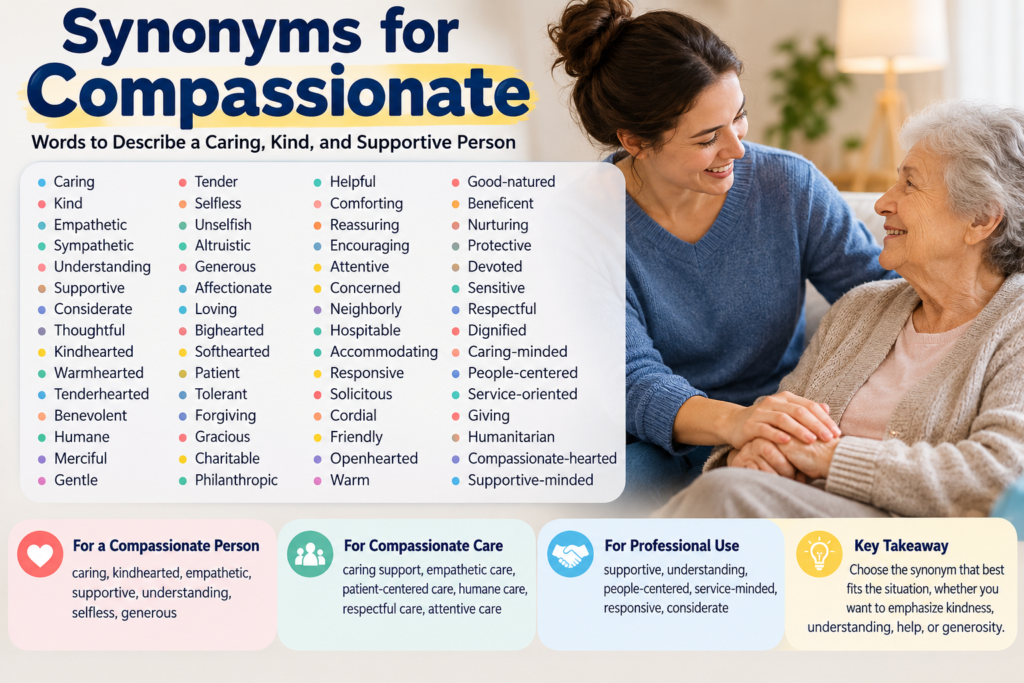
Some of the closest and most useful synonyms for compassionate include:
- Caring
- Kind
- Empathetic
- Sympathetic
- Understanding
- Considerate
- Supportive
- Tenderhearted
- Warmhearted
- Kindhearted
- Benevolent
- Humane
- Merciful
- Thoughtful
- Gentle
- Tender
- Selfless
- Unselfish
- Altruistic
- Generous
Other related alternatives can be useful depending on the situation. The larger list below explains their differences.
90+ Synonyms and Related Words for Compassionate
Not every word in this list is an exact synonym. Some describe a particular part of compassion, such as empathy, generosity, patience, or emotional support. This distinction helps you choose the most accurate word.
1. Caring
Meaning: Showing genuine concern for another person’s well-being.
Example:
She is a caring manager who checks on her employees when they are struggling.
Best for: People, relationships, families, workplaces, and everyday situations.
2. Kind
Meaning: Friendly, helpful, and considerate toward others.
Example:
The kind neighbor brought food to the family after their move.
Best for: General descriptions of good and caring behavior.
3. Empathetic
Meaning: Able to understand or recognize another person’s feelings.
Example:
A good counselor needs to be empathetic when listening to difficult experiences.
Important distinction: Empathy is mainly about understanding another person’s emotional experience. Compassion usually adds a desire to help.
4. Sympathetic
Meaning: Showing concern for someone who is experiencing difficulty or sadness.
Example:
The teacher was sympathetic when the student explained why she had missed class.
Best for: Situations involving sadness, hardship, loss, or trouble.
5. Understanding
Meaning: Showing that you recognize another person’s situation, feelings, or mistakes without rushing to judge them.
Example:
My supervisor was understanding when I needed time to deal with a family problem.
6. Supportive
Meaning: Providing encouragement, help, or emotional strength.
Example:
Her friends were supportive while she searched for a new job.
7. Considerate
Meaning: Thinking about other people’s needs and feelings before acting.
Example:
It was considerate of him to call before visiting.
8. Thoughtful
Meaning: Showing care by paying attention to another person’s needs or feelings.
Example:
It was thoughtful of Jenna to send a message after the appointment.
9. Kindhearted
Meaning: Having a naturally kind and caring character.
Example:
Everyone in the neighborhood knew him as a kindhearted man.
10. Warmhearted
Meaning: Friendly, affectionate, and emotionally kind.
Example:
She gave us a warmhearted welcome when we arrived.
11. Tenderhearted
Meaning: Easily affected by the suffering or feelings of others.
Example:
His tenderhearted nature made him especially gentle with frightened animals.
12. Benevolent
Meaning: Wanting to do good and help others.
Example:
The benevolent organization provides meals to people in need.
13. Humane
Meaning: Showing concern for the dignity, welfare, and suffering of people or animals.
Example:
The shelter is committed to humane treatment of every animal.
14. Merciful
Meaning: Showing mercy by reducing punishment, suffering, or hardship.
Example:
The judge made a merciful decision after considering the circumstances.
15. Gentle
Meaning: Calm, careful, and unlikely to cause harm or distress.
Example:
The nurse used a gentle voice to reassure the nervous child.
16. Tender
Meaning: Showing affection, sensitivity, or gentle concern.
Example:
He showed tender concern for his elderly father.
17. Selfless
Meaning: Putting the needs or interests of others ahead of your own.
Example:
Her selfless actions helped the entire community.
18. Unselfish
Meaning: Willing to give time, attention, resources, or effort without focusing mainly on personal benefit.
Example:
His unselfish decision allowed another volunteer to take the opportunity.
19. Altruistic
Meaning: Motivated by concern for other people’s welfare rather than personal gain.
Example:
Her altruistic work has helped many families.
20. Generous
Meaning: Willing to give more time, money, attention, or assistance than expected.
Example:
The generous donor helped fund the community center.
21. Compassionate
Meaning: Showing concern for another person’s suffering and a desire to help.
Example:
The doctor took a compassionate approach when discussing the patient’s concerns.
22. Affectionate
Meaning: Showing love, fondness, or emotional warmth.
Example:
The affectionate father comforted his daughter after a difficult day.
23. Loving
Meaning: Showing deep care, affection, and emotional attachment.
Example:
The children grew up in a loving home.
24. Bighearted
Meaning: Very generous, kind, and willing to help others.
Example:
A bighearted volunteer spent the weekend preparing meals for families.
25. Softhearted
Meaning: Easily moved by the difficulties or suffering of others.
Example:
Her softhearted nature made it difficult for her to ignore someone in need.
26. Good-natured
Meaning: Naturally pleasant, friendly, and easy to get along with.
Example:
His good-natured personality made new employees feel comfortable.
27. Patient
Meaning: Able to remain calm and understanding when someone needs extra time or help.
Example:
The patient instructor explained the process several times.
28. Tolerant
Meaning: Willing to accept differences, mistakes, or behaviors without unnecessary anger.
Example:
A tolerant teacher gives students room to learn from mistakes.
29. Forgiving
Meaning: Willing to let go of anger or resentment after someone has done something wrong.
Example:
She was forgiving when her friend apologized.
30. Gracious
Meaning: Polite, kind, generous, and pleasant in the way you treat others.
Example:
The host was gracious toward every guest.
31. Charitable
Meaning: Willing to give help or resources to people or causes in need.
Example:
The company supports several charitable programs.
32. Philanthropic
Meaning: Involving significant charitable giving or support for social causes.
Example:
The foundation has a philanthropic mission focused on education.
Best for: Organizations, donors, foundations, and large-scale charitable work.
33. Helpful
Meaning: Providing useful assistance to another person.
Example:
The receptionist was helpful when we had trouble finding the office.
34. Comforting
Meaning: Making someone feel safer, calmer, or less upset.
Example:
Her comforting words helped him through a stressful evening.
35. Reassuring
Meaning: Helping someone feel less worried, frightened, or uncertain.
Example:
The nurse gave the family a reassuring explanation.
36. Encouraging
Meaning: Giving someone confidence, hope, or motivation.
Example:
His encouraging words helped the student keep trying.
37. Attentive
Meaning: Paying close attention to another person’s needs or concerns.
Example:
The attentive caregiver noticed that the patient was uncomfortable.
38. Concerned
Meaning: Showing that you care about someone’s situation or welfare.
Example:
Her concerned expression showed that she had noticed something was wrong.
39. Caring-minded
Meaning: Inclined to think about the well-being of others.
Example:
The organization attracts caring-minded volunteers.
40. Neighborly
Meaning: Friendly, helpful, and considerate in the way a good neighbor would be.
Example:
Helping an elderly neighbor with groceries was a neighborly thing to do.
41. Hospitable
Meaning: Welcoming and generous toward guests.
Example:
Our hosts were hospitable and made everyone feel comfortable.
Best for: Hospitality and welcoming behavior rather than emotional support.
42. Accommodating
Meaning: Willing to adjust or make things easier for another person.
Example:
The staff was accommodating when we needed to change our appointment.
43. Responsive
Meaning: Reacting appropriately to another person’s needs or concerns.
Example:
The support team was responsive when customers reported a problem.
44. Solicitous
Meaning: Showing strong concern for someone’s health, safety, or comfort.
Example:
Her parents were solicitous during her recovery.
Best for: Formal writing.
45. Cordial
Meaning: Warm, polite, and friendly.
Example:
The two teams maintained a cordial relationship.
46. Friendly
Meaning: Pleasant, welcoming, and kind toward others.
Example:
The friendly receptionist helped us find the right department.
47. Openhearted
Meaning: Emotionally open, sincere, warm, and generous in spirit.
Example:
He gave an openhearted response to her difficult story.
48. Warm
Meaning: Friendly, affectionate, or emotionally welcoming.
Example:
She gave the new employee a warm welcome.
49. Good-natured
Meaning: Pleasant and naturally kind in temperament.
Example:
His good-natured attitude helped calm the disagreement.
50. Beneficent
Meaning: Producing or intending to produce good results for others.
Example:
The beneficent program provides resources for vulnerable families.
Best for: Formal or academic writing.
51. Benevolent-minded
Meaning: Inclined toward kindness and doing good.
Example:
The leader was viewed as benevolent-minded and fair.
52. Merciful-hearted
Meaning: Inclined to show mercy and avoid unnecessary harshness.
Example:
The merciful-hearted volunteer treated every person with dignity.
53. Soft-hearted
Meaning: Emotionally sensitive to suffering and hardship.
Example:
His soft-hearted response showed how deeply he cared.
54. Tenderhearted
Meaning: Sensitive to emotional pain and easily moved by the needs of others.
Example:
The tenderhearted volunteer spent extra time with frightened children.
55. Considerate
Meaning: Careful not to inconvenience, hurt, or upset others unnecessarily.
Example:
She was considerate of her coworker’s need for quiet.
56. Respectful
Meaning: Showing regard for another person’s dignity, rights, or feelings.
Example:
A compassionate conversation should also be respectful.
57. Dignified
Meaning: Showing respect and proper regard for another person’s worth.
Example:
The staff provided dignified support during a difficult moment.
58. Nurturing
Meaning: Providing care and encouragement that helps someone grow or recover.
Example:
The teacher created a nurturing classroom environment.
59. Protective
Meaning: Concerned with keeping someone safe from harm.
Example:
Her protective instincts became stronger when her younger brother was ill.
60. Devoted
Meaning: Giving strong and lasting care, loyalty, or attention to someone.
Example:
He is a devoted caregiver who rarely misses an important appointment.
61. Caring
Meaning: Showing concern for someone’s comfort, health, or happiness.
Example:
A caring friend listens without immediately trying to judge or criticize.
62. Sympathetic
Meaning: Showing emotional concern for someone facing difficulty.
Example:
The counselor was sympathetic to the family’s situation.
63. Empathic
Meaning: Showing or involving the ability to understand another person’s emotional experience.
Example:
Her empathic response made the conversation feel safe.
Note: “Empathetic” and “empathic” are both used in English.
64. Emotionally supportive
Meaning: Providing understanding, encouragement, comfort, and reassurance.
Example:
His emotionally supportive response helped his friend feel less alone.
65. Compassionate-minded
Meaning: Inclined to notice suffering and respond with care.
Example:
The organization looks for compassionate-minded people who enjoy helping others.
66. People-centered
Meaning: Focused on people’s needs, experiences, dignity, and well-being.
Example:
The clinic uses a people-centered approach to care.
67. Service-oriented
Meaning: Focused on helping others and meeting their needs.
Example:
Her service-oriented attitude made her a strong community volunteer.
68. Giving
Meaning: Willing to give time, energy, resources, or support to others.
Example:
He has always been giving toward friends who need help.
69. Charitable-minded
Meaning: Inclined to support people, communities, or causes in need.
Example:
Her charitable-minded approach inspired others to volunteer.
70. Generous-hearted
Meaning: Naturally generous and willing to help others.
Example:
The generous-hearted couple regularly supported local families.
71. Kind-spirited
Meaning: Having a friendly and benevolent attitude toward others.
Example:
Her kind-spirited nature was clear from the way she treated new employees.
72. Kindly
Meaning: Gentle, friendly, and considerate.
Example:
The elderly man spoke in a kindly voice.
73. Mild
Meaning: Gentle rather than harsh or aggressive.
Example:
His mild manner helped people feel comfortable sharing their concerns.
74. Gentle-natured
Meaning: Naturally calm, kind, and non-aggressive.
Example:
The gentle-natured volunteer was excellent with nervous children.
75. Caring-hearted
Meaning: Having a strong tendency to care about other people’s well-being.
Example:
Her caring-hearted personality made her a trusted friend.
76. Compassionate-hearted
Meaning: Having a strong emotional concern for people who are suffering.
Example:
The compassionate-hearted volunteer stayed late to help families find shelter.
77. Benevolent
Meaning: Showing a desire to do good for others.
Example:
The benevolent donor funded a program for children.
78. Humanitarian
Meaning: Concerned with improving human welfare and reducing suffering.
Example:
The humanitarian organization delivered supplies after the disaster.
Best for: Aid work, disaster relief, human rights, and large-scale social support.
79. Altruistic
Meaning: Concerned with helping others without making personal benefit the main goal.
Example:
His altruistic decision benefited people he had never met.
80. Self-sacrificing
Meaning: Willing to give up personal comfort, time, or advantage for someone else.
Example:
Her self-sacrificing efforts helped the family through a difficult period.
81. Other-centered
Meaning: Focused strongly on the needs and well-being of other people.
Example:
His other-centered leadership style made employees feel valued.
82. Service-minded
Meaning: Naturally interested in helping and serving others.
Example:
A service-minded employee looks for practical ways to help customers.
83. Receptive
Meaning: Open and willing to listen to another person’s feelings, ideas, or concerns.
Example:
The manager was receptive when the employee explained the problem.
84. Patient-hearted
Meaning: Calm and understanding toward people who need extra time or assistance.
Example:
The patient-hearted mentor never made beginners feel embarrassed about mistakes.
85. Forgiving-hearted
Meaning: Inclined to release anger and give others another chance.
Example:
Her forgiving-hearted nature helped repair the friendship.
86. Sensitive
Meaning: Aware of and responsive to other people’s feelings.
Example:
The speaker used sensitive language when discussing grief.
87. Caring and compassionate
Meaning: A phrase emphasizing both emotional concern and a willingness to help.
Example:
The organization is known for providing caring and compassionate support.
88. Gentle and understanding
Meaning: A useful phrase for someone who responds calmly and avoids harsh judgment.
Example:
She took a gentle and understanding approach with the frightened child.
89. Kind and supportive
Meaning: Describes someone who combines friendliness with practical or emotional help.
Example:
His kind and supportive response made the new employee feel welcome.
90. Warm and caring
Meaning: Describes someone who creates a friendly and emotionally safe environment.
Example:
The counselor had a warm and caring manner.
91. Empathetic and supportive
Meaning: Describes someone who understands feelings and responds with useful encouragement or help.
Example:
A good mentor should be empathetic and supportive.
92. Humane and considerate
Meaning: Describes treatment that respects another person’s dignity while taking their needs into account.
Example:
The company adopted a more humane and considerate policy for employees facing hardship.
The Best Synonyms for a Compassionate Person
If you are looking for words to describe a compassionate person, the best choices depend on the person’s behavior.
Here are some strong options:
| Word | What it emphasizes |
| Caring | Genuine concern |
| Kindhearted | A naturally kind personality |
| Empathetic | Understanding feelings |
| Supportive | Providing help and encouragement |
| Understanding | Avoiding harsh judgment |
| Selfless | Putting others first |
| Altruistic | Helping without seeking personal gain |
| Benevolent | Wanting to do good |
| Tenderhearted | Sensitive to suffering |
| Warmhearted | Emotional warmth and kindness |
| Thoughtful | Paying attention to others’ needs |
| Considerate | Respecting others’ feelings and comfort |
| Humane | Respecting dignity and reducing suffering |
| Generous | Freely giving time, money, or assistance |
| Nurturing | Helping others feel safe and develop |
| Patient | Remaining calm with people who need time |
| Merciful | Showing mercy rather than harshness |
| Humanitarian | Helping people on a broader social scale |
Example description
Instead of writing:
She is a compassionate person.
You could write:
She is a kindhearted, empathetic, and supportive person who always makes time for people who need help.
The second sentence gives the reader more information about the type of compassion being shown.
Synonyms for Compassionate Care
“Compassionate care” is commonly used when talking about healthcare, caregiving, counseling, social services, customer support, and other situations where someone’s comfort and well-being matter.
Useful alternatives include:
- caring support
- empathetic care
- person-centered care
- patient-centered care
- humane care
- supportive care
- gentle care
- thoughtful care
- sensitive care
- individualized care
- respectful care
- emotional support
- compassionate support
- attentive care
- holistic support
- dignified care
- nurturing care
- responsive care
- considerate service
- human-centered care
The best replacement depends on the context.
For example, patient-centered care emphasizes the needs and preferences of a patient. Empathetic care emphasizes understanding the patient’s feelings. Humane care emphasizes dignity and freedom from unnecessary suffering. These expressions overlap with compassionate care but are not identical.
Compassionate vs. Caring
“Compassionate” and “caring” are very close, but there is a small difference.
Caring means showing concern for someone’s well-being.
Compassionate usually has a stronger connection to suffering, hardship, or distress and often suggests a desire to help.
Compare:
She is a caring mother.
This tells us that she looks after her children and cares about them.
She was compassionate toward her friend after the loss.
This highlights her response to another person’s suffering.
In many everyday sentences, either word can work. However, “compassionate” is often more specific when someone is dealing with pain or hardship.
Compassionate vs. Empathetic
These words are often confused.
Empathetic focuses on understanding another person’s feelings.
Compassionate focuses on caring about that person’s suffering and wanting to help.
For example:
An empathetic friend understands why you feel upset.
A compassionate friend understands your pain and looks for a way to support you.
A person can be empathetic without taking action. Compassion often involves a caring response.
Compassionate vs. Sympathetic
Sympathy means feeling concern or sorrow for someone who is experiencing difficulty.
Empathy is more about understanding or sharing the person’s emotional perspective.
Compassion combines concern for suffering with a desire to help.
For example:
- Sympathetic: “I am sorry you are going through this.”
- Empathetic: “I can understand why this feels overwhelming.”
- Compassionate: “I understand this is difficult, and I want to help.”
These distinctions are useful when you need the most precise word.
Compassionate vs. Kind
“Kind” is broader than “compassionate.”
A person can be kind by:
- holding a door open
- giving someone a compliment
- sharing food
- helping with a task
- speaking politely
Compassion is especially associated with responding to suffering, difficulty, or vulnerability.
Therefore, “kind” is a good general alternative, but it does not always carry the same emotional meaning as “compassionate.”
Choosing the Right Synonym for Compassionate
The easiest way to choose a synonym is to decide what part of compassion you want to emphasize.
If you mean emotional understanding
Use:
- empathetic
- empathic
- understanding
- sensitive
- receptive
If you mean kindness
Use:
- kind
- kindly
- kindhearted
- kind-spirited
- gentle
- warmhearted
If you mean practical help
Use:
- helpful
- supportive
- accommodating
- responsive
- attentive
- service-minded
If you mean generosity
Use:
- generous
- giving
- charitable
- philanthropic
- bighearted
- selfless
If you mean concern for suffering
Use:
- sympathetic
- tenderhearted
- softhearted
- humane
- merciful
- compassionate
If you mean putting others first
Use:
- selfless
- unselfish
- altruistic
- other-centered
- self-sacrificing
Synonyms for Compassionate in Professional Writing
In professional writing, the best alternative may depend on the industry.
For healthcare, consider:
- patient-centered
- empathetic
- attentive
- humane
- respectful
- supportive
- person-centered
For customer service:
- caring
- helpful
- responsive
- considerate
- accommodating
- understanding
For leadership:
- supportive
- understanding
- considerate
- people-centered
- empathetic
- fair-minded
For nonprofit and charity work:
- humanitarian
- charitable
- altruistic
- benevolent
- philanthropic
- service-minded
For education:
- supportive
- patient
- understanding
- nurturing
- encouraging
- empathetic
Synonyms for Compassionate in a Resume
If you are writing a resume, simply using “compassionate” repeatedly can make your descriptions sound generic. Choose a word that explains the actual skill.
Instead of:
Compassionate employee who helps customers.
You might write:
Supportive customer service professional who listens carefully to concerns and provides practical solutions.
Instead of:
Compassionate caregiver.
You could write:
Caring caregiver experienced in providing attentive, respectful, and person-centered support.
Specific wording is usually stronger than adding several similar adjectives.
How to Use Compassionate in a Sentence
Here are several natural examples:
- The nurse provided compassionate care during a difficult time.
- She took a compassionate approach to the student’s situation.
- His compassionate response helped everyone feel heard.
- The organization provides compassionate support to families in need.
- A compassionate leader listens before making a decision.
- Her compassionate nature makes people comfortable sharing their problems.
- The counselor used compassionate language throughout the conversation.
- He is known for being compassionate toward people facing hardship.
Common Mistakes When Using Synonyms for Compassionate
Not every positive word means exactly the same thing.
1. Treating empathy and compassion as identical
They are closely related, but empathy focuses more on understanding feelings, while compassion includes concern for suffering and often a wish to help.
2. Using “pity” as a direct replacement
Pity can suggest looking down on someone or viewing them as unfortunate. Compassion generally carries a more respectful sense of concern.
3. Using “lenient” when you mean caring
Lenient means not being strict or severe with rules or punishment. It does not automatically mean emotionally compassionate.
4. Using “hospitable” for every kind person
Hospitable specifically relates to welcoming and treating guests or visitors well.
5. Using “philanthropic” for ordinary kindness
Philanthropic usually refers to substantial charitable giving or organized support for causes. It is not the natural word for every small act of kindness.
6. Choosing a word only because it sounds formal
A simple word such as “caring” may be clearer and stronger than a rare word that readers do not commonly use.
How to Make Your Writing More Compassionate
Using a synonym is only one way to create compassionate language. The wording around it also matters.
Instead of judging someone immediately, describe their situation.
Instead of:
He was careless about the problem.
Try:
He may have been overwhelmed and needed more support.
Instead of:
She failed again.
Try:
She is still learning and may benefit from additional guidance.
Compassionate writing does not mean avoiding facts. It means describing people and difficult situations with fairness, dignity, and care.
Frequently Asked Questions
What are the closest synonyms for compassionate?
The closest everyday alternatives are caring, kindhearted, empathetic, sympathetic, understanding, supportive, tenderhearted, benevolent, humane, and considerate. The best choice depends on whether you want to emphasize emotional understanding, kindness, help, or concern for suffering.
What is another word for a compassionate person?
Good choices include caring person, kindhearted person, empathetic person, understanding person, supportive person, benevolent person, selfless person, and tenderhearted person.
What is a synonym for compassionate care?
Depending on the context, alternatives include caring support, empathetic care, patient-centered care, person-centered care, humane care, supportive care, attentive care, respectful care, and dignified care.
What is the difference between compassionate and empathetic?
Empathy mainly involves understanding another person’s feelings or perspective. Compassion involves concern for suffering and usually includes a desire to help. They often appear together, but they describe different qualities.
What is the difference between compassionate and sympathetic?
Sympathetic usually means feeling or expressing concern for someone who is experiencing difficulty. Compassion goes further by emphasizing care for the person’s suffering and a willingness to help.
Is “kind” a synonym for compassionate?
Yes, “kind” can be used as a synonym in many situations, but it is broader. Kindness can describe any pleasant or helpful behavior, while compassion is especially connected with responding to suffering or hardship.
Is “caring” the best synonym for compassionate?
“Caring” is one of the most natural alternatives in everyday English. It is especially useful when describing someone’s personality, relationships, or concern for another person’s well-being.
Is “humane” the same as compassionate?
They overlap, but they are not identical. Humane emphasizes treating people or animals with dignity and avoiding unnecessary suffering. Compassionate emphasizes concern for another person’s suffering and a desire to help.
Can “generous” mean compassionate?
Sometimes. A generous person willingly gives time, money, resources, or assistance. A compassionate person responds to suffering with care. Generosity can be one expression of compassion, but the two words are not interchangeable in every sentence.
What is a strong synonym for compassionate in a resume?
Depending on the job, useful choices include empathetic, supportive, attentive, patient-centered, understanding, caring, people-centered, and service-minded. Choose the word that describes the actual skill you can demonstrate.
What is a formal word for compassionate?
Depending on the meaning, benevolent, humane, altruistic, humanitarian, solicitous, beneficent, or empathetic may work. However, formal does not always mean better. Choose the clearest word for your audience.
What is the opposite of compassionate?
Common opposites include uncaring, insensitive, indifferent, cruel, harsh, heartless, unsympathetic, and unfeeling. The correct opposite depends on the specific quality being contrasted.
Can compassionate describe a person?
Yes. For example:
She is a compassionate person who takes time to help people in difficult situations.
It can also describe behavior, communication, treatment, leadership, care, and professional services.
Can compassionate describe writing?
Yes. Writing can be described as compassionate when it discusses people, struggles, or sensitive subjects with empathy, respect, fairness, and care.
Which synonym for compassionate is easiest for everyday English?
Caring, kind, supportive, understanding, and helpful are among the easiest and most natural choices.
Final Thoughts
The best synonym for “compassionate” depends on the exact idea you want to communicate. If you mean general kindness, kind or caring may be enough. If you want to emphasize emotional understanding, choose empathetic or understanding. If you mean practical help, supportive, helpful, or responsive may be more precise. For generosity, consider selfless, altruistic, or generous.
Learning these distinctions gives you more than a longer vocabulary list. It helps you describe people’s actions, personalities, and relationships more accurately.
When in doubt, choose the word that explains the specific kind of compassion you mean rather than simply choosing the most unusual synonym. Clear, natural language is usually more effective than complicated vocabulary.


