



100+ Synonyms of Balance With Examples and Explanations (2026)
Balance is an important word in English because it describes how different things can remain steady, fair, equal, or properly arranged. You might use it when talking about standing on one foot, managing work and family responsibilities, checking a bank account, or deciding whether two sides of an argument are equally strong.
However, balance does not mean exactly the same thing in every situation. A person may need emotional stability, a business may need financial equilibrium, and a bank account may have a remaining balance. Each situation calls for different vocabulary.
Learning synonyms for balance helps you choose words that express your meaning more accurately. It also improves your writing, expands your vocabulary, and prevents you from repeating the same word in every sentence.
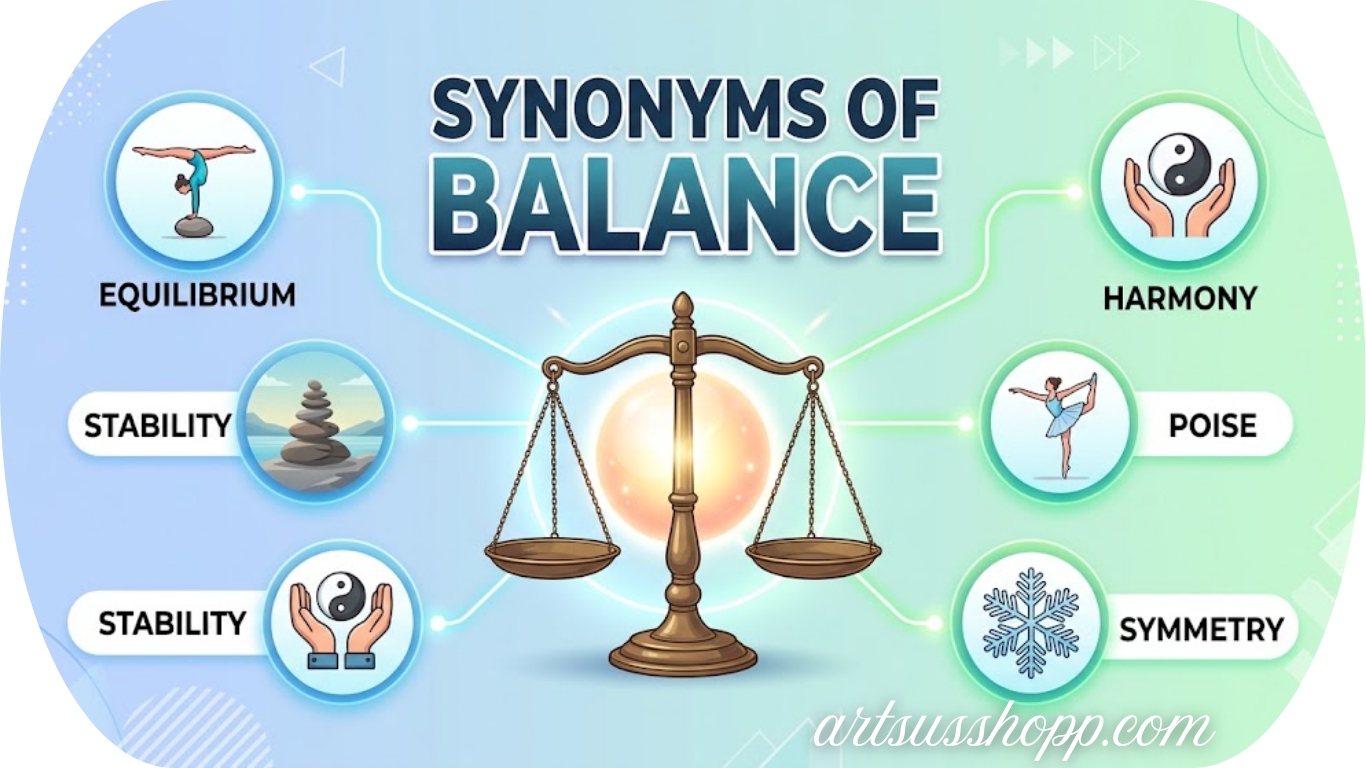
For example, stability may be the best choice when describing a reliable system, while harmony may suit a peaceful relationship. Equality works when discussing equal rights, and equilibrium is useful when describing forces that are balanced.
This guide explains the definition of balance, its pronunciation, grammar, related words, antonyms, and more than 100 useful alternatives organized by meaning. You will also learn how to choose a balance synonym for money, work-life balance, physical movement, emotional control, and other common situations.
What Is the Meaning of Balance?
Balance means a condition in which different forces, amounts, needs, or parts are properly related, stable, or equal. The exact meaning depends on the context.
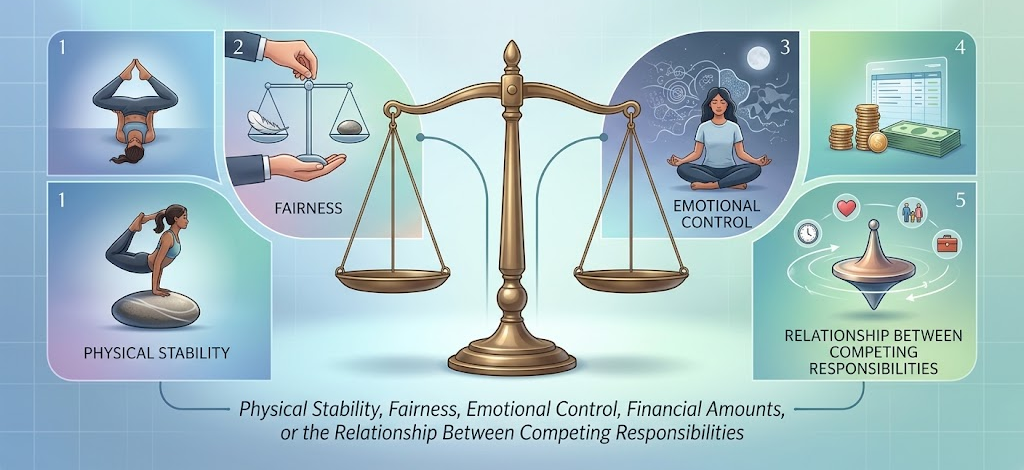
Balance can describe physical stability, fairness, emotional control, financial amounts, or the relationship between competing responsibilities.
Balance as a Noun
As a noun, balance refers to a state of stability, an appropriate relationship between different things, or the amount remaining in an account.
Examples:
- The gymnast demonstrated excellent balance on the beam.
- A healthy balance between work and rest improves daily life.
- The remaining balance on the invoice is $150.
- The painting has a pleasing balance of colors.
Balance as a Verb
As a verb, balance means to keep something steady, make different parts work together, or bring amounts into an appropriate relationship.
Examples:
- She can balance a book on her head.
- The company needs to balance its expenses and income.
- Parents often balance work responsibilities with family time.
- The government introduced new measures to balance the budget.
Is Balance an Adjective?
No. Balance is mainly used as a noun and a verb. The adjective is usually balanced, which describes something that is stable, fair, reasonable, or properly arranged.
Examples:
- She made a balanced decision.
- The meal contains a balanced mix of nutrients.
- He has a balanced approach to difficult problems.
The word balancing can function as a verb form or adjective, depending on its use in a sentence.
What Is Another Word for Balance?
The best alternative depends on the intended meaning.
| Meaning of balance | Suitable synonym |
| Physical steadiness | Stability |
| Equal forces | Equilibrium |
| Peaceful relationships | Harmony |
| Fair treatment | Fairness |
| Equal rights or amounts | Equality |
| Emotional control | Composure |
| Proper arrangement | Proportion |
| Avoiding excess | Moderation |
| Financial amount remaining | Remainder |
| Managing work and personal life | Work-life harmony |
| Keeping something steady | Stabilize |
| Making amounts equal | Equalize |
| A system of opposing forces | Counterbalance |
| Equal representation or power | Parity |
| Correct positioning | Alignment |
The words in this table are related to balance, but they are not interchangeable in every sentence. Always consider what the original sentence is trying to communicate.
100+ Synonyms of Balance With Examples and Explanations
The following list contains alternatives grouped by their meanings. Some are close synonyms, while others work only in particular contexts.
1. Synonyms for Stability and Physical Balance
Also Read: 100+ Synonyms of Reveal with Examples and Explanations (2026)
These words describe steadiness, physical control, or the ability to remain secure without falling or changing unexpectedly.
1. Stability
Meaning: The condition of being steady or unlikely to change suddenly.
Example: Regular maintenance helps maintain the stability of the bridge.
2. Equilibrium
Meaning: A state in which opposing forces are balanced.
Example: The object returned to equilibrium after the movement stopped.
3. Steadiness
Meaning: The quality of remaining firm or controlled.
Example: The surgeon’s steadiness was important during the procedure.
4. Poise
Meaning: Physical control or calm confidence, especially under pressure.
Example: The dancer maintained her poise throughout the performance.
5. Steadfastness
Meaning: The quality of remaining firm and committed.
Example: Her steadfastness helped the team finish the difficult project.
6. Firmness
Meaning: The quality of being stable, strong, or decisive.
Example: The chair’s firmness made it comfortable to sit on.
7. Security
Meaning: A condition of being protected or free from serious danger.
Example: A strong foundation gives the structure greater security.
8. Groundedness
Meaning: A feeling of being stable, realistic, and emotionally centered.
Example: Spending time outdoors gives him a sense of groundedness.
9. Centering
Meaning: The process of bringing attention or position toward a stable center.
Example: Deep breathing helped her regain her centering before the presentation.
10. Surefootedness
Meaning: The ability to move confidently without slipping or losing physical control.
Example: The hiker’s surefootedness helped on the rocky trail.
11. Stability of position
Meaning: The ability to remain in a secure position.
Example: The equipment was tested for stability of position.
12. Constancy
Meaning: The quality of remaining steady or consistent.
Example: The constancy of the temperature helped protect the stored materials.
13. Resilience
Meaning: The ability to recover after difficulty or change.
Example: Emotional resilience helped him adjust to a new job.
14. Durability
Meaning: The ability to remain useful despite wear or pressure.
Example: The durability of the material made the equipment reliable.
15. Firm footing
Meaning: A secure physical position or a strong basis for action.
Example: The climber searched for firm footing before moving forward.
2. Synonyms for Harmony and Proper Relationships
These words are useful when balance refers to peaceful relationships, attractive arrangements, or different elements working well together.
16. Harmony
Meaning: A pleasing relationship between people, ideas, or parts.
Example: The team worked in harmony to complete the assignment.
17. Concord
Meaning: Agreement or peaceful relations.
Example: The two departments reached a state of concord.
18. Agreement
Meaning: A shared understanding or acceptance.
Example: The partners reached an agreement about their responsibilities.
19. Compatibility
Meaning: The ability of people or things to work well together.
Example: Compatibility between the software and hardware improved performance.
20. Coherence
Meaning: The quality of forming a clear and connected whole.
Example: The writer improved the coherence of the essay.
21. Unity
Meaning: The condition of being joined or working together.
Example: The design creates unity between the room’s different elements.
22. Coordination
Meaning: The organized combination of actions or parts.
Example: Good coordination helped the players defend effectively.
23. Integration
Meaning: The process of combining different parts into a functioning whole.
Example: The integration of work and family schedules reduced stress.
24. Symmetry
Meaning: A matching arrangement of corresponding parts.
Example: The building’s symmetry gives it a pleasing appearance.
25. Proportion
Meaning: The proper relationship between the sizes or amounts of different parts.
Example: The artist adjusted the proportions of the figures.
26. Congruence
Meaning: Agreement or consistency between ideas, facts, or parts.
Example: There was congruence between the company’s stated values and its actions.
27. Compatibility of interests
Meaning: A condition in which different interests can coexist without major conflict.
Example: The agreement reflected the compatibility of both parties’ interests.
28. Cohesion
Meaning: The quality of parts remaining connected as a group.
Example: Shared goals strengthened the cohesion of the team.
29. Synchronization
Meaning: The process of making actions or events occur together at the right time.
Example: The dancers practiced synchronization before the show.
30. Alignment
Meaning: The condition of being properly positioned or in agreement.
Example: The project requires alignment between the team’s goals and its budget.
3. Synonyms for Fairness, Equality, and Equal Power
Use these alternatives when balance refers to fair treatment, equal opportunities, comparable amounts, or the distribution of power.
31. Equality
Meaning: The condition of having the same rights, status, or opportunities.
Example: The organization promotes equality in the workplace.
32. Fairness
Meaning: Treating people or situations in a just and reasonable way.
Example: The manager considered fairness when assigning shifts.
33. Equity
Meaning: Fair treatment that considers different needs and circumstances.
Example: The program aims to improve equity in access to education.
34. Parity
Meaning: Equality in amount, status, value, or power.
Example: The two teams achieved parity in the final quarter.
35. Impartiality
Meaning: The quality of judging without favoring one side.
Example: A good mediator must demonstrate impartiality.
36. Neutrality
Meaning: The condition of not supporting either side in a dispute.
Example: The organization maintained neutrality during the negotiations.
37. Justice
Meaning: Fair treatment according to laws, rights, or accepted principles.
Example: The community called for justice for everyone involved.
38. Evenhandedness
Meaning: Fair and equal treatment of different people or sides.
Example: The supervisor was respected for her evenhandedness.
39. Equitability
Meaning: The quality of being fair and reasonable.
Example: The policy was reviewed to improve its equitability.
40. Equalization
Meaning: The process of making differences in amounts, levels, or conditions smaller or eliminating them.
Example: Equalization of funding helped reduce the gap between schools.
41. Proportionality
Meaning: The condition in which one part is appropriate in relation to another.
Example: The committee considered the proportionality of the proposed penalties.
42. Reciprocal arrangement
Meaning: An arrangement in which each side gives or receives something in return.
Example: The reciprocal arrangement helped both businesses share resources.
43. Equivalence
Meaning: The condition of having the same value, meaning, or effect.
Example: The teacher explained the equivalence of the two measurements.
44. Equal standing
Meaning: A position in which people or groups have the same status or rights.
Example: The agreement gave both partners equal standing.
45. Representation
Meaning: The inclusion of different groups or viewpoints in a decision-making process.
Example: The committee reviewed representation to ensure that different communities were heard.
4. Synonyms for Organization, Order, and Arrangement
These words fit situations in which balance means that different elements are arranged correctly or function in an orderly way.
46. Order
Meaning: A condition in which things are arranged properly.
Example: The new filing system brought order to the office.
47. Organization
Meaning: The arrangement of people, information, or activities into a useful system.
Example: Better organization helped the student manage several assignments.
48. Structure
Meaning: The way different parts are arranged and connected.
Example: The report has a clear structure.
49. Arrangement
Meaning: The way objects, ideas, or responsibilities are placed or organized.
Example: The seating arrangement improved the flow of the event.
50. System
Meaning: A set of connected parts that work together.
Example: The company created a system for tracking expenses.
51. Regularity
Meaning: The quality of following a consistent pattern.
Example: The regularity of the schedule helped employees plan their days.
52. Uniformity
Meaning: The condition of being consistent or similar throughout.
Example: The instructions promoted uniformity across all departments.
53. Consistency
Meaning: The quality of maintaining a steady standard or pattern.
Example: Consistency in practice helped her improve.
54. Orderliness
Meaning: The quality of being neat and organized.
Example: The orderliness of the workspace made documents easier to find.
55. Organization of parts
Meaning: The arrangement of individual elements into a functional whole.
Example: The organization of parts made the machine easier to repair.
56. Calibration
Meaning: The process of adjusting an instrument to provide accurate measurements.
Example: Calibration helped ensure that the scale measured weight correctly.
57. Regulation
Meaning: The act of controlling or adjusting something according to a standard.
Example: Temperature regulation kept the laboratory conditions stable.
58. Adjustment
Meaning: A change made to improve position, condition, or performance.
Example: A small adjustment brought the wheels into alignment.
59. Arrangement of forces
Meaning: The positioning of forces so they interact in a particular way.
Example: The engineer studied the arrangement of forces before approving the design.
60. Optimization
Meaning: The process of making the best use of available resources or conditions.
Example: Optimization of the schedule reduced waiting time.
5. Synonyms for Emotional Balance and Calmness
When balance refers to emotional control, mental steadiness, or a calm response to pressure, these words may fit better than general synonyms.
61. Composure
Meaning: The ability to remain calm and controlled.
Example: She maintained her composure during the difficult interview.
62. Calmness
Meaning: A peaceful state without strong agitation.
Example: His calmness helped everyone focus on the solution.
63. Serenity
Meaning: A state of deep peace and quiet.
Example: The quiet garden gave her a feeling of serenity.
64. Tranquility
Meaning: A condition of peace and freedom from disturbance.
Example: The countryside offered tranquility after a busy week.
65. Equanimity
Meaning: Mental calmness when facing stress or difficulty.
Example: He responded to criticism with equanimity.
66. Self-control
Meaning: The ability to manage one’s emotions and actions.
Example: Self-control helped her avoid an unnecessary argument.
67. Emotional stability
Meaning: The ability to respond to feelings in a reasonably steady way.
Example: A regular routine can support emotional stability.
68. Moderation
Meaning: Avoiding extremes in behavior, habits, or decisions.
Example: Moderation is useful when managing screen time.
69. Restraint
Meaning: The ability to hold back an action or reaction.
Example: He showed restraint when the discussion became tense.
70. Temperance
Meaning: The practice of controlling desires or avoiding excess.
Example: Temperance helped her maintain healthier spending habits.
71. Levelheadedness
Meaning: The ability to think clearly and calmly.
Example: Her levelheadedness helped the group make a practical decision.
72. Mindfulness
Meaning: Paying attention to the present moment without immediately reacting.
Example: Mindfulness helped him notice stress before it became overwhelming.
73. Emotional regulation
Meaning: The ability to manage emotional responses appropriately.
Example: Emotional regulation helped the student cope with disappointment.
74. Inner peace
Meaning: A feeling of calm and acceptance.
Example: She found inner peace by spending time away from daily distractions.
75. Self-possession
Meaning: Confidence and control over one’s reactions.
Example: He answered the unexpected question with self-possession.
6. Synonyms for Managing Responsibilities and Work-Life Balance
These terms are especially useful when discussing time management, competing priorities, personal responsibilities, and the relationship between work and private life.
76. Work-life harmony
Meaning: A way of arranging work and personal life so they support one another.
Example: Flexible hours helped employees achieve better work-life harmony.
77. Work-life integration
Meaning: An approach that allows work and personal responsibilities to fit together.
Example: Remote work gave her more options for work-life integration.
78. Time management
Meaning: Planning and using time effectively.
Example: Good time management helped him finish his assignments on time.
79. Prioritization
Meaning: Deciding which tasks or responsibilities matter most.
Example: Prioritization helped the team focus on urgent deadlines.
80. Compromise
Meaning: An agreement in which each side accepts some changes to reach a workable result.
Example: The couple reached a compromise about household responsibilities.
81. Adaptability
Meaning: The ability to adjust to changing conditions.
Example: Adaptability helped the employee manage a changing schedule.
82. Flexibility
Meaning: The ability to change plans or methods when necessary.
Example: Flexibility made it easier to manage family commitments.
83. Resource allocation
Meaning: The distribution of time, money, people, or materials according to needs.
Example: Careful resource allocation helped the business stay within budget.
84. Workload management
Meaning: Organizing tasks so that responsibilities remain manageable.
Example: Workload management reduced pressure on the project team.
85. Coordination of responsibilities
Meaning: Organizing different duties so they can be completed effectively.
Example: Coordination of responsibilities helped both parents manage busy schedules.
86. Sustainable pace
Meaning: A rate of work or activity that can be maintained without excessive strain.
Example: A sustainable pace helped the team avoid burnout during the project.
87. Priorities in proportion
Meaning: Giving appropriate attention to different needs or tasks.
Example: She kept her priorities in proportion during the busy season.
88. Distribution
Meaning: The way something is divided or shared among people or groups.
Example: A fair distribution of duties improved the team’s performance.
89. Scheduling
Meaning: Arranging tasks or events at suitable times.
Example: Better scheduling allowed him to attend classes and work part-time.
90. Moderated workload
Meaning: A workload adjusted to a manageable level.
Example: A moderated workload gave employees more time to recover between demanding assignments.
7. Synonyms for Financial Balance and Money
Financial balance has a more specific meaning than physical or emotional balance. A financial synonym must fit the type of amount being discussed.
91. Account balance
Meaning: The amount recorded in an account at a particular time.
Example: She checked her account balance before making the purchase.
92. Remaining amount
Meaning: The part of a total that has not yet been used or paid.
Example: The remaining amount was due by the end of the month.
93. Remainder
Meaning: What is left after a part has been removed, spent, or paid.
Example: He used the remainder of the budget for supplies.
94. Outstanding balance
Meaning: The amount still owed on a bill, loan, or account.
Example: The customer paid the outstanding balance before the deadline.
95. Unpaid amount
Meaning: Money that remains due but has not been paid.
Example: The unpaid amount appeared on the latest invoice.
96. Net balance
Meaning: The resulting amount after relevant credits, debits, or adjustments have been considered.
Example: The accountant calculated the net balance after recording the transactions.
97. Surplus
Meaning: An amount left over when available resources exceed requirements or spending.
Example: The business recorded a budget surplus at the end of the year.
98. Financial position
Meaning: The overall condition of a person’s or organization’s finances.
Example: The annual report explained the company’s financial position.
99. Credit balance
Meaning: An amount recorded on the credit side of an account; in some account types, it may represent a positive amount available.
Example: The accountant checked the credit balance before preparing the report.
100. Residual amount
Meaning: The amount remaining after other amounts have been accounted for.
Example: The residual amount was transferred to the reserve fund.
Also Read:100+ Synonyms of Successful with Example and Explanation 2026
101. Net amount
Meaning: The amount remaining after specified deductions or adjustments.
Example: The net amount was lower than the original invoice total.
102. Difference
Meaning: The amount by which two values are unequal.
Example: The accountant investigated the difference between the recorded and actual totals.
103. Reconciliation
Meaning: The process of comparing records to identify and resolve differences.
Example: Bank reconciliation helped the business identify a missing transaction.
104. Total remaining
Meaning: The complete amount still available or unpaid.
Example: The report showed the total remaining after all expenses were deducted.
105. Equity
Meaning: In finance, the value of an ownership interest after relevant liabilities are deducted from assets.
Example: The homeowner calculated the equity in the property.
Note that account balance, outstanding balance, surplus, and equity have different technical meanings. They should not be substituted for one another without checking the financial context.
8. Synonyms for Balancing, Equalizing, and Counteracting
When balance is used as a verb, you may need a word that describes making things equal, keeping something steady, or reducing the effect of another force.
106. Equalize
Meaning: To make things equal or more nearly equal.
Example: The new policy aimed to equalize access to educational resources.
107. Even out
Meaning: To make differences less noticeable or distribute something more evenly.
Example: The company adjusted staffing levels to even out the workload.
108. Stabilize
Meaning: To make something steady or less likely to change suddenly.
Example: The support beams helped stabilize the structure.
109. Counterbalance
Meaning: To offset the effect or weight of something with an opposing influence.
Example: Additional savings helped counterbalance the unexpected expense.
110. Offset
Meaning: To compensate for or reduce the effect of something.
Example: Lower transportation costs helped offset the increase in rent.
111. Compensate for
Meaning: To make up for a disadvantage, loss, or difference.
Example: Extra practice helped compensate for the limited training time.
112. Adjust
Meaning: To change something slightly to improve its fit, position, or condition.
Example: The technician adjusted the equipment for greater accuracy.
113. Reconcile
Meaning: To make different accounts, facts, or viewpoints consistent or compatible.
Example: The accountant worked to reconcile the two financial records.
114. Regulate
Meaning: To control or maintain something within an appropriate range.
Example: The device regulates the room temperature.
115. Harmonize
Meaning: To make different elements work together smoothly.
Example: The designer harmonized the colors throughout the room.
116. Coordinate
Meaning: To organize activities or parts so they work together.
Example: The manager coordinated the schedules of three departments.
117. Equalize out
Meaning: An informal expression sometimes used to mean making differences even; in most polished writing, simply use equalize or even out.
Example: The adjustments helped even out the differences between the two totals.
118. Level
Meaning: To make something flat or bring levels closer together.
Example: The worker leveled the surface before installing the tiles.
119. Balance out
Meaning: To offset differences or produce a more even overall result.
Example: A quiet morning helped balance out a stressful afternoon.
120. Rebalance
Meaning: To adjust the parts of a system or distribution to achieve a more suitable relationship.
Example: The company rebalanced its budget after sales declined.
Synonyms for Balance in Different Contexts
The best balance synonym depends on the subject. A word that works in a physical situation may sound incorrect in a financial sentence.
Work-Life Balance Synonym
When discussing work-life balance, useful alternatives include work-life harmony, work-life integration, personal-professional balance, and a sustainable work routine.
Example: Flexible scheduling helped the employees achieve better work-life harmony.
Work-life balance usually refers to managing professional duties alongside family, personal interests, health, and rest. Work-life integration places more emphasis on allowing these areas to fit together rather than keeping them completely separate.
The phrase work-life-balance synonym may appear in searches, but standard writing normally uses work-life balance as a noun phrase without adding extra hyphens.
Off-Balance Synonym
Off balance usually means physically unsteady or mentally unsettled.
Possible alternatives include:
- Unsteady
- Unbalanced
- Wobbly
- Unstable
- Disoriented
- Unsettled
- Uncentered
Example: The sudden movement left him unsteady.
In the expression caught off balance, alternatives such as surprised, unprepared, or wrong-footed may fit better.
Remaining Balance Synonym
When referring to money left after a payment, suitable alternatives include remaining amount, outstanding amount, unpaid amount, amount due, and remainder.
Example: The remaining amount on the invoice must be paid by Friday.
Choose carefully because remaining balance can mean money still available in an account, while outstanding balance usually refers to an amount that remains owed.
Check-and-Balance Synonym
The expression checks and balances refers to safeguards that prevent one person, group, or institution from gaining excessive power.
Related expressions include:
- Oversight
- Accountability
- Mutual control
- Safeguards
- Separation of powers
- Institutional restraints
Example: Independent oversight provides an important safeguard against misuse of authority.
In government, checks and balances has a specific constitutional meaning. General words such as fairness or equilibrium do not always convey that meaning accurately.
Balance Synonym for Money
For money-related contexts, the most useful alternatives include account balance, remaining amount, outstanding balance, net balance, credit balance, and amount due.
Examples:
- The account balance shows the amount recorded in the account.
- The outstanding balance shows how much remains unpaid.
- The net balance reflects the result after relevant adjustments.
- The remaining amount shows what is left after a payment.
There is no single financial synonym that works for every type of balance. Always identify whether you mean money available, money owed, or the result of a calculation.
Right Balance Synonym
The phrase right balance often refers to the most suitable relationship between competing needs or qualities.
Possible alternatives include proper proportion, ideal mix, appropriate equilibrium, suitable combination, and harmonious arrangement.
Example: The right balance of practice and rest helped the athlete improve.
Counterbalance Synonym
When counterbalance is a noun or verb, related words include offset, compensation, counterweight, corrective force, and opposing influence.
Example: The heavier base acted as a counterweight to the upper structure.
Counterbalance is especially useful when one factor reduces or offsets the effect of another.
A Balance Synonym
The phrase a balance can refer to a state of equilibrium, an appropriate mix, or a financial amount.
Examples:
- A balance of power: an equal or comparable distribution of influence.
- A balance of opinion: a fair consideration of different viewpoints.
- An account balance: the amount recorded in an account.
- A balance between work and rest: an appropriate relationship between activities.
The correct alternative depends on the full expression rather than the word balance alone.
Sense-of-Balance Synonym
In physical movement, a sense of balance is the ability to maintain body position and control movement.
Related terms include postural control, physical stability, coordination, bodily steadiness, and equilibrium.
Example: Practicing simple standing exercises can help improve postural control.
In scientific and medical contexts, balance can involve several systems working together, including information from the inner ear, vision, and body-position sensors.
Cosmic Balance Synonym
Cosmic balance is an expression used in philosophical, spiritual, or literary discussions about harmony in the universe.
Related expressions include universal harmony, cosmic equilibrium, universal order, and the balance of nature.
Example: The poet used cosmic equilibrium as a symbol of harmony throughout the universe.
These are contextual alternatives rather than exact scientific synonyms. Cosmic balance does not have one fixed technical definition across all fields.
Power-Balance Synonym
A power balance describes how authority or influence is distributed among people, groups, or nations.
Related expressions include distribution of power, balance of power, power parity, relative influence, and equilibrium of power.
Example: The agreement changed the distribution of power between the two organizations.
In international relations, the balance of power has a specific political meaning involving the relative strength of states.
Balance Synonyms in English: How to Choose the Right Word
Using a synonym correctly requires more than finding a word with a similar dictionary definition. You also need to consider the sentence, subject, tone, and intended meaning.
Choose Stability for Reliability
Use stability when you mean that something remains secure or does not change suddenly.
Original: The company needs balance during the transition.
Alternative: The company needs stability during the transition.
Stability is more precise when reliability is the main idea.
Choose Harmony for Peaceful Relationships
Use harmony when people, ideas, or elements work together without serious conflict.
Original: The family wants balance at home.
Alternative: The family wants harmony at home.
Harmony emphasizes cooperation and peaceful relationships rather than equal amounts.
Choose Equilibrium for Opposing Forces
Use equilibrium when different forces or influences offset each other.
Original: The system returned to balance.
Alternative: The system returned to equilibrium.
This word is particularly useful in science, physics, economics, and formal explanations.
Choose Equality for Equal Rights or Amounts
Use equality when the sentence concerns equal status, rights, opportunities, or values.
Original: The policy aims for balance between the two groups.
Alternative: The policy aims for equality between the two groups.
If the groups have different needs and fairness requires different support, equity may be more appropriate than equality.
Choose Moderation for Avoiding Excess
Use moderation when discussing habits, spending, food, exercise, or behavior.
Original: Balance is important when using social media.
Alternative: Moderation is important when using social media.
Moderation emphasizes avoiding extremes, while balance may refer to the broader relationship between social media and other activities.
Choose Proportion for Relationships Between Parts
Use proportion when the relative size, amount, or importance of different parts matters.
Original: The design needs better balance.
Alternative: The design needs better proportion.
Proportion is especially useful in art, architecture, writing, and visual design.
Choose Offset When One Thing Compensates for Another
Use offset when one factor reduces the effect of another.
Original: Savings helped balance the extra expense.
Alternative: Savings helped offset the extra expense.
Offset works well in financial and practical contexts, but it does not necessarily mean that the final amounts are exactly equal.
Is Balance a Synonym for Equalize?
No. Balance and equalize are related, but they have different grammatical roles and meanings.
Balance can be a noun or verb. Equalize is a verb that means to make two or more things equal or more nearly equal.
Examples:
- Balance: The balance between income and spending improved.
- Balance as a verb: The manager balanced the budget.
- Equalize: The organization worked to equalize opportunities.
Equalize often focuses on reducing differences between amounts, levels, or conditions. Balance can refer to a wider relationship in which the parts work together appropriately, even if they are not identical.
Synonyms for Equalize
Useful alternatives include even out, level, make equal, standardize, bring into line, and equalize differences.
Examples:
- The team adjusted the assignments to even out the workload.
- The technician leveled the surface.
- The new process helped standardize the measurements.
Not every alternative means exactly the same thing. Standardize means to follow a common standard, while equalize means to make things equal or more nearly equal.
Equalize and Equalise: Which Spelling Is Correct?
Both spellings are correct.
- Equalize is the standard spelling in American English.
- Equalise is commonly used in British English.
The same spelling pattern appears in related words such as equalization and equalisation. For a US audience, use equalize and equalization unless a publication’s style guide says otherwise.
Synonyms for Balancing and Balanced
The form of the word changes how it works in a sentence.
Another Word for Balancing
Balancing can describe the action of keeping something steady or managing competing responsibilities.
Useful alternatives include:
- Stabilizing
- Equalizing
- Adjusting
- Coordinating
- Managing
- Harmonizing
- Offsetting
- Reconciling
- Regulating
- Rebalancing
Example: Balancing several projects requires careful planning.
Alternative: Managing several projects requires careful planning.
Another Word for Balanced
Balanced is an adjective that can mean stable, fair, reasonable, or properly proportioned.
Useful alternatives include:
- Stable
- Evenhanded
- Fair
- Proportionate
- Harmonious
- Well-rounded
- Moderate
- Reasonable
- Composed
- Equitable
- Centered
- Steady
Example: She presented a balanced argument.
Alternative: She presented a fair and evenhanded argument.
The best word depends on what makes the original subject balanced. A balanced diet, balanced argument, and balanced budget do not all require the same synonym.
Descriptive Words for Balance
Descriptive words help explain what kind of balance a person, system, or arrangement has.
| Descriptive word | What it emphasizes |
| Stable | Reliability and steadiness |
| Harmonious | Peaceful relationships |
| Equitable | Fair treatment |
| Proportionate | Appropriate relative amounts |
| Symmetrical | Matching or corresponding parts |
| Centered | Position around a middle point |
| Steady | Consistent movement or condition |
| Moderate | Avoidance of extremes |
| Organized | Clear and orderly arrangement |
| Controlled | Managed actions or forces |
| Evenhanded | Fair treatment of different sides |
| Well-rounded | A suitable variety of qualities or experiences |
| Sustainable | A condition that can continue over time |
| Coordinated | Parts working together effectively |
| Consistent | A stable pattern or standard |
These words are related to balance but have different meanings. For instance, symmetrical describes matching arrangements, while equitable focuses on fairness.
Antonyms of Balance
A balance antonym describes a lack of stability, fairness, order, or appropriate proportion. The best opposite depends on the context.
1. Imbalance
Meaning: A condition in which different parts are not properly balanced.
Example: An imbalance between spending and income can create financial pressure.
2. Instability
Meaning: A condition that is not steady or secure.
Example: Political instability affected the country’s economy.
3. Disorder
Meaning: A lack of organization or proper arrangement.
Example: Poor planning led to disorder in the office.
4. Inequality
Meaning: A difference in rights, status, opportunities, or amounts.
Example: The report examined inequality in access to education.
5. Unfairness
Meaning: Treatment that is not just or reasonable.
Example: The employees complained about unfairness in the promotion process.
6. Chaos
Meaning: A state of extreme confusion or disorder.
Example: The unexpected cancellation created chaos at the station.
7. Disproportion
Meaning: An unsuitable relationship between the sizes or amounts of different parts.
Example: The designer corrected the disproportion between the room’s furniture and its available space.
8. Disharmony
Meaning: A lack of agreement or peaceful cooperation.
Example: Poor communication created disharmony within the group.
9. Unevenness
Meaning: A lack of uniformity or consistency.
Example: The unevenness of the surface made walking difficult.
10. Unsteadiness
Meaning: The condition of being physically or figuratively unstable.
Example: The sudden movement caused unsteadiness.
11. Excess
Meaning: More of something than is appropriate or necessary.
Example: Excess spending reduced the amount available for savings.
12. Deficiency
Meaning: A shortage or lack of something needed.
Also Read: 150 Synonyms of Focus With Examples and Explanations 2026
Example: A deficiency in funding delayed the project.
Balance does not have one universal antonym. Imbalance is a general opposite, instability works for physical or system-related contexts, and inequality is more suitable when discussing unequal conditions.
Etymology and Pronunciation of Balance
The word balance entered English through Old French, with its history connected to Latin bilanx, meaning “having two scales.” The original idea relates to weighing objects against one another.
Over time, the word expanded beyond physical weighing. Today, it can refer to financial accounts, emotional control, fairness, responsibilities, and the relationship between different forces.
Pronunciation
- American English IPA: /ˈbæl.əns/
- British English IPA: /ˈbæl.əns/
- Syllables: bal-ance
- Part of speech: Noun and verb
The pronunciation is broadly similar in American and British English, although individual accents may differ slightly.
Word Forms of Balance
| Word form | Part of speech | Example |
| Balance | Noun or verb | The balance is correct. |
| Balanced | Adjective or past-tense verb | She made a balanced choice. |
| Balancing | Verb form or adjective | Balancing responsibilities takes planning. |
| Balances | Plural noun or verb form | The report lists the balances. |
| Imbalance | Noun | The test revealed an imbalance. |
| Unbalanced | Adjective | The argument presented an unbalanced view. |
| Rebalance | Verb | The company will rebalance its budget. |
| Rebalanced | Past-tense verb or adjective | The portfolio was rebalanced. |
Balance does not normally require a prefix or suffix to function as a noun or verb. Its related forms are created through common English word-building patterns.
Common Mistakes When Using Balance Synonyms
Treating Every Synonym as an Exact Replacement
Words such as harmony, equilibrium, equality, and stability overlap in meaning but are not identical.
Incorrect choice: The outstanding harmony on my credit card is $200.
Better: The outstanding balance on my credit card is $200.
Harmony describes agreement or peaceful relationships, not money owed.
Confusing Balance With Equality
Balance does not always require two things to be equal. A balanced schedule might give more time to work on one day and more time to family on another, depending on current needs.
Equality is appropriate when the amounts, rights, or opportunities should be equal. Balance is broader and may involve suitable proportions rather than identical quantities.
Using Financial Terms Interchangeably
An account balance is not always the same as an outstanding balance. The former refers to the amount recorded in an account, while the latter generally means an amount still owed.
Likewise, surplus means an amount left over beyond requirements, and equity refers to ownership value after relevant liabilities are deducted from assets.
Using a Noun Where a Verb Is Needed
Balance and equalize can both describe actions, but the sentence structure must be correct.
Example: The company needs to balance its expenses.
Example: The company needs to equalize the two amounts.
A sentence such as “The company needs balance the expenses” is grammatically incorrect. Use “needs to balance” or “needs balance” only when balance is being used as a noun in an appropriate construction.
Choosing Complicated Words When Simple Ones Work Better
Words such as equilibrium, equanimity, and proportionality can be useful, but they may sound too formal in everyday conversation.
For basic English writing, steady, fair, calm, even, and organized may communicate the intended meaning more clearly.
Frequently Asked Questions About Balance Synonyms
What is the most common synonym for balance?
Stability is a common alternative when balance means steadiness. Harmony works for peaceful relationships, equality for equal rights or amounts, and equilibrium for opposing forces. The best choice depends on the sentence.
What is a rare or uncommon word for balance?
Equanimity, equipoise, and poise are useful less-common alternatives in certain contexts. Equanimity means mental calmness under pressure, while equipoise refers to a state of balance or equal distribution. Poise can describe physical control or calm confidence.
Is equilibrium the same as balance?
The words are closely related but not always interchangeable. Equilibrium often describes a condition in which opposing forces cancel one another or a system remains stable. Balance can also refer to fairness, financial amounts, or the management of daily responsibilities.
What is the difference between balance and counterbalance?
Balance describes a state of stability or an appropriate relationship between parts. Counterbalance refers to something that offsets or opposes another force, influence, or amount. A counterweight, for example, can help balance a structure.
What is another word for maintaining balance?
Depending on the situation, maintaining balance can mean stabilizing, regulating, coordinating, adjusting, or keeping things in equilibrium. For responsibilities, managing priorities may be more natural. For physical movement, maintaining stability is often appropriate.
What is a synonym for a balanced person?
A balanced person may be described as levelheaded, composed, sensible, steady, emotionally stable, or well-rounded. These terms emphasize different qualities, so choose the one that best describes the person’s behavior.
What is the difference between balance and moderation?
Balance usually describes the relationship between different parts or needs. Moderation means avoiding excess. For example, a balanced lifestyle includes work, rest, and personal activities, while moderation may refer to avoiding excessive work or spending.
Conclusion
Learning synonyms of balance helps you express ideas more clearly in everyday conversations, school assignments, professional documents, and financial discussions. However, the best alternative depends on what balance means in a particular sentence.
Stability and steadiness describe physical or structural reliability. Harmony and coordination explain how different parts work together. Equality, equity, and parity relate to fairness or comparable conditions, while composure and equanimity describe emotional control. In financial writing, terms such as account balance, outstanding balance, and net balance have specific meanings that should not be confused.
When looking for another word for balance, start by identifying the idea you want to communicate. Then choose the word that matches the context, tone, and grammatical role. Use simple words when they communicate your meaning clearly, and choose more specialized terms when precision matters.
With regular practice, you can build a stronger English vocabulary, reduce repetition, and use balance synonyms naturally and accurately.


Pingback: 100+ Synonyms for Underscore: Meaning, Examples, and Usage (2026) - artsusshop .com/