



100 Synonyms of Ideology With Examples and Explanations (2026)
The word ideology means a system of beliefs, ideas, or values that influences how people think, make decisions, and understand the world. For example, people who believe in equality, freedom, or traditional values may support different ideologies because they have different ideas about how society should work.
People use the word ideology in politics, religion, education, philosophy, business, and social discussions. It helps explain why individuals and groups support particular goals, policies, or ways of life. However, repeating the same word too often can make writing less engaging.
Learning an ideology synonym helps English learners expand their vocabulary and communicate more clearly. Words such as belief system, philosophy, doctrine, worldview, and school of thought can replace ideology in suitable contexts. Each word has a slightly different meaning, so choosing the right alternative is important.
In this article, you will learn the meaning, pronunciation, history, and grammatical forms of ideology. You will also discover 100 relevant synonyms and related expressions with examples, explore political ideology synonyms, and learn about ideology antonyms and common vocabulary questions.
Table of Contents
- Meaning of Ideology
- Connotative Meaning
- Etymology and History
- Pronunciation (US and UK – IPA)
- Syllables
- Word Formation of Ideology
- Synonyms of Ideology
- Prototype Meaning
- Prototype Categorization
- Political, Religious, and Social Ideology Synonyms
- Ideology Synonyms and Antonyms
- Synonyms for Ideological and Ideologies
- Short Questions and Answers
- Conclusion
Meaning of Ideology
Definition
Ideology (noun): A connected system of beliefs, ideas, or values that guides how a person or group thinks and acts.
An ideology may concern government, society, religion, economics, education, or personal values. It can influence people’s decisions, opinions, goals, and relationships with others.
Examples
- The political party follows an ideology that supports individual freedom.
- Her ideology emphasizes equality and social responsibility.
- Different ideologies can lead people to disagree about public policies.
What’s Another Word for Ideology?
A common ideology synonym is belief system. Other useful alternatives include philosophy, doctrine, creed, worldview, and school of thought.
For example, “The organization follows a particular ideology” could become “The organization follows a particular belief system.” The alternative works because both expressions describe connected beliefs that influence behavior.
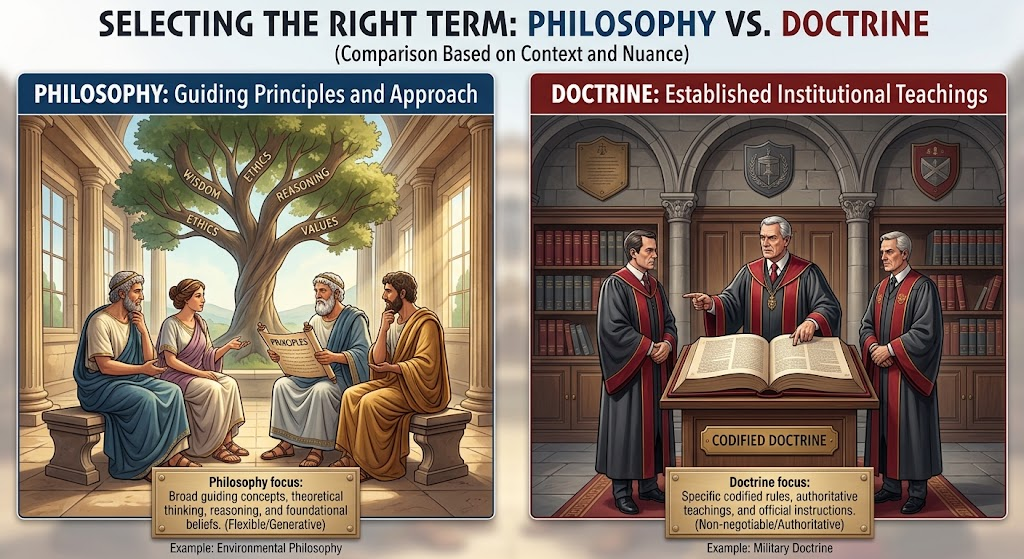
However, philosophy may be more appropriate when discussing general principles, while doctrine often refers to established teachings. The best synonym depends on the sentence.
Connotative Meaning of Ideology
Connotation refers to the feelings or associations a word may suggest beyond its basic definition.
The word ideology can have positive, negative, or neutral associations depending on the context.
- Positive associations: vision, principles, shared values, guidance.
- Negative associations: dogma, extremism, rigid thinking, prejudice.
- Neutral associations: belief system, worldview, philosophy, system of ideas.
For example, a writer may describe an ideology of equality in a positive context. In contrast, an ideology that promotes racial superiority may be described as a racist ideology.
The word itself does not automatically mean something good or bad. Its meaning depends on the beliefs and actions associated with it.
Etymology and History of Ideology
The word ideology comes from French idéologie, a term associated with the systematic study of ideas. Its roots are connected to the Greek words idea, meaning an idea or form, and logos, meaning word, account, or study.
The French philosopher Antoine Destutt de Tracy helped establish the term in the late eighteenth century. Over time, its meaning developed from the study of ideas into the broader modern meaning of a system of beliefs, particularly in political and social contexts.
Today, ideology is widely used in philosophy, political science, sociology, history, and everyday communication.
Pronunciation of Ideology (US and UK – IPA)
The word ideology has slightly different vowel sounds in American and British English.
- US pronunciation: /ˌaɪdiˈɑːlədʒi/
- UK pronunciation: /ˌaɪdiˈɒlədʒi/
The main stress falls on the “ol” sound in both pronunciations.
Syllables in Ideology
The word ideology is commonly divided into five syllables:
i-de-ol-o-gy
Practicing the word slowly can help English learners pronounce it more confidently.
Word Formation of Ideology
Understanding the related forms of ideology helps you use the word correctly in sentences.
- Ideology (noun): A system of beliefs or ideas.
- Ideological (adjective): Related to an ideology.
- Ideologically (adverb): In a way connected to an ideology.
- Ideologist (noun): A person who studies, develops, or promotes ideological ideas.
- Ideologue (noun): A person strongly committed to a particular ideology.
Example: The groups were ideologically different because they supported different political beliefs.
Synonyms of Ideology
The following list includes common ideology synonyms, their meanings, and examples. Some words are close synonyms, while others are related terms that fit specific contexts.
1. Belief System (Noun)
Meaning: A connected group of beliefs that influences how someone thinks or behaves.
Examples:
- Every community may have a distinct belief system.
- His belief system emphasizes honesty and respect.
2. Philosophy (Noun)
Meaning: A set of ideas or principles about life, knowledge, or behavior.
Examples:
- Her philosophy encourages independent thinking.
- The company follows a philosophy of customer service.
3. Doctrine (Noun)
Meaning: An established set of teachings or principles.
Examples:
- The religious community follows a specific doctrine.
- Political doctrine influenced the movement’s goals.
4. Creed (Noun)
Meaning: A set of beliefs that a person or group strongly accepts.
Examples:
- Honesty became his personal creed.
- The organization follows a creed of peaceful cooperation.
5. Worldview (Noun)
Meaning: A person’s general way of understanding the world.
Examples:
- Travel changed her worldview.
- His worldview was shaped by education and experience.
6. Mindset (Noun)
Meaning: A person’s usual way of thinking.
Examples:
- A flexible mindset can help people learn.
- Her mindset influenced how she approached problems.
7. Principles (Noun)
Meaning: Basic beliefs or rules that guide decisions and behavior.
Examples:
- He follows strong principles.
- Their principles emphasize fairness.
8. Values (Noun)
Meaning: Beliefs about what is important or desirable.
Examples:
- Family values influence many personal decisions.
- The school promotes values such as honesty.
9. Theory (Noun)
Meaning: A connected set of ideas used to explain something.
Examples:
- The researcher tested the theory.
- Political theory examines government and justice.
10. Dogma (Noun)
Meaning: A belief or teaching treated as unquestionably true.
Examples:
- The discussion challenged traditional dogma.
- The leader refused to question the group’s dogma.
11. Conviction (Noun)
Meaning: A strong personal belief.
Examples:
- She spoke with deep conviction.
- His convictions influenced his public service.
12. Faith (Noun)
Meaning: Strong belief or trust, especially in religious matters.
Examples:
- Her faith gave her hope.
- The community shares a strong religious faith.
13. Outlook (Noun)
Meaning: A general attitude toward life or a particular subject.
Examples:
- She has a positive outlook.
- His political outlook changed over time.
14. Perspective (Noun)
Meaning: A particular way of understanding an issue.
Examples:
- Education can change your perspective.
- Her perspective helped the group consider another solution.
15. Ethics (Noun)
Meaning: Principles concerning right and wrong behavior.
Examples:
- Business ethics influence company decisions.
- Medical ethics guide healthcare professionals.
16. Morality (Noun)
Meaning: Beliefs and standards about right and wrong.
Examples:
- The novel explores morality and responsibility.
- Morality can influence how people judge difficult decisions.
17. Political Theory (Noun)
Meaning: The systematic study of political ideas, government, and justice.
Examples:
- She studied political theory at university.
- The book explains different approaches to political authority.
18. Platform (Noun)
Meaning: A statement of a political party’s policies and commitments.
Examples:
- The party announced its platform.
- The candidate’s platform includes education reform.
19. School of Thought (Noun)
Meaning: A group of people who share a particular intellectual approach.
Examples:
- One school of thought supports gradual change.
- Another school of thought favors a different approach.
20. Teaching (Noun)
Meaning: An idea or principle taught by a person, institution, or tradition.
Examples:
- Religious teachings influenced the community.
- The teacher explained the moral teachings behind the story.
21. Manifesto (Noun)
Meaning: A public statement explaining a group’s beliefs, aims, or proposed changes.
Examples:
- The movement published a manifesto.
- The political manifesto outlined several reforms.
22. Code (Noun)
Meaning: A set of rules or standards that guide behavior.
Examples:
- The team follows a moral code.
- The organization introduced a code of conduct.
23. Viewpoint (Noun)
Meaning: A person’s opinion or position on a subject.
Examples:
- Everyone has a different viewpoint.
- Her viewpoint was considered during the discussion.
24. Principle (Noun)
Meaning: A basic belief or rule that guides action.
Examples:
- Freedom is an important principle.
- He follows a principle of fairness.
25. Agenda (Noun)
Meaning: A set of goals or priorities that a person or group wants to pursue.
Examples:
- The organization has a social agenda.
- Critics questioned the group’s political agenda.
26. Rationalism (Noun)
Meaning: A philosophical approach that gives reason an important role in gaining knowledge.
Examples:
- Rationalism emphasizes the role of reason.
- Philosophers have debated rationalism for centuries.
27. Humanism (Noun)
Meaning: A broad tradition that emphasizes human dignity, agency, or human interests.
Examples:
- Humanism influenced the writer’s ideas about education.
- The discussion explored humanism and human rights.
28. Nationalism (Noun)
Meaning: A political idea emphasizing national identity, unity, or self-determination.
Examples:
- Nationalism influenced the independence movement.
- The historian studied nationalism in the region.
29. Liberalism (Noun)
Meaning: A political tradition that generally emphasizes individual liberty and rights.
Examples:
- Liberalism has influenced modern political thought.
- The class compared liberalism with other traditions.
30. Conservatism (Noun)
Meaning: A political tradition that generally emphasizes continuity, established institutions, or traditional values.
Examples:
- Conservatism influenced the debate about social change.
- His political views reflected conservatism.
31. Beliefs (Noun)
Meaning: Ideas that someone accepts as true.
Examples:
- Her beliefs influence her choices.
- Their beliefs about education differ.
32. Set of Beliefs (Noun Phrase)
Meaning: Several connected beliefs held by a person or group.
Examples:
- The movement developed a set of beliefs about equality.
- Their set of beliefs influenced their decisions.
33. System of Ideas (Noun Phrase)
Meaning: An organized collection of related ideas.
Examples:
- The author examined the system of ideas behind the movement.
- The system of ideas shaped the group’s goals.
34. Value System (Noun)
Meaning: The collection of values that guides a person’s decisions.
Examples:
- Her value system emphasizes honesty.
- The organization’s value system promotes responsibility.
35. Guiding Principles (Noun Phrase)
Meaning: Core beliefs that direct behavior and decisions.
Examples:
- The group’s guiding principles encourage cooperation.
- Guiding principles can help organizations make difficult choices.
36. Core Values (Noun Phrase)
Meaning: The most important values held by a person or organization.
Examples:
- The company’s core values include integrity.
- Their core values shaped the project’s direction.
37. Tenets (Noun)
Meaning: The main principles of a philosophy, religion, or movement.
Examples:
- Equality is one of the movement’s central tenets.
- The book explains the tenets of the tradition.
38. Precepts (Noun)
Meaning: Rules or principles intended to guide behavior.
Examples:
- The teacher explained the ethical precepts.
- The community follows precepts passed down through generations.
39. Worldview Framework (Noun Phrase)
Meaning: An organized structure of assumptions used to understand the world.
Examples:
- The researcher examined the worldview framework behind the debate.
- A worldview framework can influence how people interpret events.
40. Intellectual Tradition (Noun Phrase)
Meaning: A continuing approach to ideas developed by thinkers over time.
Examples:
- The debate belongs to a long intellectual tradition.
- The university studies an intellectual tradition focused on justice.
41. Social Philosophy (Noun Phrase)
Meaning: Ideas about how people should live together and organize society.
Examples:
- Her social philosophy emphasizes equal opportunity.
- The movement developed a social philosophy based on cooperation.
42. Social Theory (Noun Phrase)
Meaning: An explanation of social relationships, institutions, and behavior.
Examples:
- The researcher used social theory to study inequality.
- Social theory can help explain changes in society.
43. Social Doctrine (Noun Phrase)
Meaning: A set of teachings about social organization and responsibilities.
Examples:
- The organization developed a social doctrine.
- The course explores social doctrine and public responsibility.
44. Political Philosophy (Noun Phrase)
Meaning: Ideas about government, political authority, justice, and freedom.
Examples:
- Political philosophy examines questions of justice.
- The author compared two political philosophies.
45. Political Doctrine (Noun Phrase)
Meaning: An established set of political teachings or principles.
Examples:
- The movement followed a political doctrine.
- Political doctrine influenced the group’s decisions.
46. Political Outlook (Noun Phrase)
Meaning: A general attitude toward political issues.
Examples:
- Her political outlook changed after the election.
- Their political outlook influenced their policy preferences.
47. Political Orientation (Noun Phrase)
Meaning: The general direction of someone’s political beliefs.
Examples:
- The survey examined political orientation.
- Political orientation can influence voting preferences.
48. Political Beliefs (Noun Phrase)
Meaning: Ideas about government, laws, and public affairs.
Examples:
- Their political beliefs differ.
- Political beliefs can influence public debate.
49. Political Principles (Noun Phrase)
Meaning: Core values that guide political decisions.
Examples:
- The representative defended political principles related to liberty.
- Political principles influenced the proposed reforms.
50. Political Vision (Noun Phrase)
Meaning: An idea of how government or society should develop.
Examples:
- The leader presented a political vision.
- Her political vision focuses on education and employment.
51. Political Program (Noun Phrase)
Meaning: A set of political goals and proposed actions.
Examples:
- The party introduced a political program.
- The political program focuses on public services.
52. Political Creed (Noun Phrase)
Meaning: A strongly held set of political beliefs.
Examples:
- His political creed emphasizes individual rights.
- The speech explained the politician’s political creed.
53. Political Worldview (Noun Phrase)
Meaning: A general understanding of politics and public institutions.
Examples:
- Her political worldview was shaped by history.
- The book examines the political worldview of different leaders.
54. Social Worldview (Noun Phrase)
Meaning: A general understanding of society and social relationships.
Examples:
- The experience changed his social worldview.
- Their social worldview influenced community decisions.
55. Cultural Values (Noun Phrase)
Meaning: Shared beliefs about what matters within a culture.
Examples:
- Cultural values influence social customs.
- The study explored cultural values across generations.
56. Cultural Philosophy (Noun Phrase)
Meaning: Ideas about culture, identity, and social practices.
Examples:
- The writer explored a cultural philosophy of belonging.
- Cultural philosophy can influence artistic expression.
57. Religious Doctrine (Noun Phrase)
Meaning: Established teachings associated with a religion.
Examples:
- The class examined religious doctrine.
- Religious doctrine influenced the community’s traditions.
58. Religious Beliefs (Noun Phrase)
Meaning: Beliefs concerning religion and spiritual matters.
Examples:
- Religious beliefs influence ceremonies.
- The study explored religious beliefs across communities.
59. Religious Philosophy (Noun Phrase)
Meaning: Philosophical ideas about faith, religion, and spiritual questions.
Examples:
- The book explores religious philosophy.
- Religious philosophy raises questions about faith and knowledge.
60. Theology (Noun)
Meaning: The systematic study of religious beliefs and questions about the divine.
Examples:
- She studied theology at university.
- The course introduces major themes in theology.
61. Spiritual Outlook (Noun Phrase)
Meaning: A person’s general approach to spiritual questions.
Examples:
- Her spiritual outlook emphasizes compassion.
- His spiritual outlook influenced his daily practices.
62. Economic Philosophy (Noun Phrase)
Meaning: Ideas about how an economy should operate.
Examples:
- The policy reflects a particular economic philosophy.
- The debate compared different economic philosophies.
63. Economic Ideology (Noun Phrase)
Meaning: Beliefs about markets, ownership, economic power, and resource distribution.
Examples:
- The debate revealed differences in economic ideology.
- Economic ideology can influence public policy.
64. Educational Philosophy (Noun Phrase)
Meaning: Beliefs about teaching, learning, and education.
Examples:
- The school’s educational philosophy encourages curiosity.
- Her educational philosophy emphasizes student participation.
65. Organizational Philosophy (Noun Phrase)
Meaning: Principles that guide an organization’s decisions and practices.
Examples:
- The company’s organizational philosophy emphasizes teamwork.
- The manager explained the organization’s philosophy.
66. Ethical Framework (Noun Phrase)
Meaning: A structured set of standards for evaluating decisions.
Examples:
- The hospital uses an ethical framework.
- An ethical framework can guide difficult choices.
67. Moral Code (Noun Phrase)
Meaning: A set of rules about proper behavior.
Examples:
- The character follows a moral code.
- The community’s moral code emphasizes honesty.
68. Moral Philosophy (Noun Phrase)
Meaning: The study of right and wrong, duties, and moral values.
Examples:
- The course introduces moral philosophy.
- Moral philosophy examines difficult ethical questions.
69. Rationalism (Noun)
Meaning: A philosophical approach that emphasizes reason in gaining knowledge.
Examples:
- Rationalism influenced the philosopher’s work.
- Students compared rationalism with other approaches to knowledge.
70. Humanism (Noun)
Meaning: A tradition emphasizing human dignity and human interests.
Examples:
- Humanism influenced the author’s educational ideas.
- The discussion explored humanism and individual dignity.
71. Individualism (Noun)
Meaning: A principle or outlook emphasizing individual independence and personal rights.
Examples:
- Individualism influences many political debates.
- The writer examined individualism and responsibility.
72. Collectivism (Noun)
Meaning: An outlook that emphasizes the group or collective over individual interests in particular areas.
Examples:
- Collectivism shaped the movement’s approach to shared resources.
- The course compared individualism and collectivism.
73. Socialism (Noun)
Meaning: A family of political and economic traditions emphasizing social ownership, control, or greater collective responsibility in economic life.
Examples:
- Socialism has influenced political movements.
- The students examined different forms of socialism.
74. Capitalism (Noun)
Meaning: An economic system in which private ownership and markets play major roles.
Examples:
- Capitalism influences how many businesses operate.
- The debate examined capitalism and economic inequality.
75. Communism (Noun)
Meaning: A political and economic tradition associated with a classless society and collective ownership of productive resources.
Examples:
- Communism influenced several twentieth-century political movements.
- The historian studied the development of communism.
76. Libertarianism (Noun)
Meaning: A political philosophy that gives strong importance to individual liberty and limits on coercive authority.
Examples:
- Libertarianism emphasizes individual freedom.
- The class compared libertarianism with other political traditions.
77. Progressivism (Noun)
Meaning: A political or social outlook that supports reform and progress toward particular social goals.
Examples:
- Progressivism influenced the reform movement.
- The article examines progressivism and public policy.
78. Traditionalism (Noun)
Meaning: An outlook that values established customs and traditions.
Examples:
- Traditionalism influenced the community’s practices.
- The debate explored traditionalism and social change.
79. Nationalism (Noun)
Meaning: A political idea emphasizing national identity, unity, or self-determination.
Examples:
- Nationalism influenced the independence movement.
- The historian examined nationalism in modern politics.
80. Conservatism (Noun)
Meaning: A political tradition that generally values continuity and established institutions.
Examples:
- Conservatism influenced the policy debate.
- The course explores conservatism in different countries.
81. Liberalism (Noun)
Meaning: A political tradition that generally emphasizes individual liberty and rights.
Examples:
- Liberalism influenced modern political thought.
- The students compared liberalism with conservatism.
82. Ideological Position (Noun Phrase)
Meaning: A specific position based on a system of beliefs.
Examples:
- The candidate explained her ideological position.
- The two groups have different ideological positions.
83. Ideological Stance (Noun Phrase)
Meaning: A clearly expressed position based on ideological beliefs.
Examples:
- The newspaper discussed the party’s ideological stance.
- His ideological stance influenced his public statements.
84. Ideological Alignment (Noun Phrase)
Meaning: The degree to which beliefs agree between people or groups.
Examples:
- Ideological alignment helped the organizations cooperate.
- The researchers studied ideological alignment among voters.
85. Ideological Orientation (Noun Phrase)
Meaning: The general direction of someone’s ideological beliefs.
Examples:
- The survey explored ideological orientation.
- Ideological orientation influenced the group’s priorities.
86. Ideological Commitment (Noun Phrase)
Meaning: Strong support for a particular system of beliefs.
Examples:
- Her ideological commitment influenced her advocacy.
- The study examined ideological commitment among members.
87. Ideological Perspective (Noun Phrase)
Meaning: A way of interpreting events through particular beliefs.
Examples:
- The author examined the issue from an ideological perspective.
- Different ideological perspectives produced different conclusions.
88. Ideological Framework (Noun Phrase)
Meaning: A structure of ideas used to interpret events or guide decisions.
Examples:
- The researcher used an ideological framework.
- The framework helped explain the group’s priorities.
89. Ideological Tradition (Noun Phrase)
Meaning: A body of beliefs and arguments developed over time.
Examples:
- The movement belongs to a long ideological tradition.
- The book explores an ideological tradition in political history.
90. Ideological Model (Noun Phrase)
Meaning: A representation of how a system of beliefs is organized or operates.
Examples:
- The researcher compared two ideological models.
- The model helped explain the movement’s assumptions.
91. Ideological Paradigm (Noun Phrase)
Meaning: A broad pattern of ideas and assumptions used to interpret the world.
Examples:
- The discovery challenged the dominant ideological paradigm.
- The article examines a changing ideological paradigm.
92. Ideological Doctrine (Noun Phrase)
Meaning: A set of teachings associated with a particular ideology.
Examples:
- The historian examined the ideological doctrine.
- Ideological doctrine influenced the movement’s direction.
93. Ideological System (Noun Phrase)
Meaning: A connected structure of beliefs that influences interpretations and decisions.
Examples:
- The book describes the ideological system behind the policy.
- The ideological system shaped the organization’s priorities.
94. Ideological Agenda (Noun Phrase)
Meaning: A set of goals or priorities associated with an ideology.
Examples:
- Critics questioned the campaign’s ideological agenda.
- The group explained its ideological agenda.
95. Ideological Platform (Noun Phrase)
Meaning: A set of stated positions and policies reflecting ideological beliefs.
Examples:
- The party revised its ideological platform.
- The ideological platform included several proposed reforms.
96. Ideological Vision (Noun Phrase)
Meaning: An idea of how society should develop according to particular beliefs.
Examples:
- The movement presented an ideological vision.
- The leader explained an ideological vision for reform.
97. Ideological Conflict (Noun Phrase)
Meaning: Disagreement between people or groups with different underlying beliefs.
Examples:
- Ideological conflict affected the negotiations.
- The debate revealed an ideological conflict.
98. Ideological Differences (Noun Phrase)
Meaning: Differences between the beliefs or principles of people or groups.
Examples:
- Ideological differences divided the organizations.
- The discussion explored ideological differences between the candidates.
99. Ideological Shift (Noun Phrase)
Meaning: A change in a person’s or group’s ideological position.
Examples:
- The election marked an ideological shift.
- The article examines an ideological shift in public opinion.
100. Dominant Ideology (Noun Phrase)
Meaning: A system of beliefs that strongly influences a society’s institutions or widely accepted ideas.
Examples:
- The documentary explored how dominant ideology shaped public attitudes.
- Historians studied the influence of dominant ideology on social institutions.
Prototype Meaning of Ideology
The prototype meaning of ideology is a connected system of beliefs that guides how people understand the world and make decisions. When people hear the word, they often think of political parties, religious traditions, social movements, or philosophies that influence public behavior.
For example, a political party may support a particular ideology because it has shared beliefs about government and economic policy. A religious community may follow established teachings that guide its practices. An individual may have a personal philosophy that influences decisions about work, family, and responsibility.
These examples show that ideology can operate at different levels, from personal beliefs to broad social systems.
Prototype Categorization of Ideology
Ideology can be grouped into several categories according to the subject it addresses.
- Political beliefs: liberalism, conservatism, nationalism, socialism.
- Personal thinking: worldview, mindset, personal philosophy, outlook.
- Moral systems: ethics, morality, moral code, guiding principles.
- Religious ideas: doctrine, theology, religious beliefs, religious philosophy.
- Economic ideas: capitalism, socialism, economic philosophy, economic ideology.
- Academic approaches: theory, school of thought, rationalism, intellectual tradition.
- Social beliefs: social philosophy, social theory, cultural values, social doctrine.
This categorization helps writers choose a more accurate ideology synonym according to the context.
Political, Religious, and Social Ideology Synonyms
Different forms of ideology require different vocabulary. The following distinctions are especially useful when targeting more specific searches.
Political Ideology Synonym
A political ideology synonym may include political philosophy, political doctrine, political outlook, political orientation, or political belief system.
Example: The party’s political philosophy emphasizes individual liberty.
Use political platform when discussing declared policies and political doctrine when referring to an established set of political teachings.
Religious Ideology Synonym
A religious ideology synonym may include religious doctrine, religious philosophy, religious worldview, or system of religious beliefs.
Example: The community’s religious worldview influences its traditions.
Theology is suitable when discussing the systematic study of religious beliefs rather than the complete belief system itself.
Social Ideology Synonym
A social ideology synonym may include social philosophy, social doctrine, social worldview, or social belief system.
Example: The movement’s social philosophy focuses on equal access to education.
Social theory is more appropriate when the discussion concerns explanations of how society works.
Racial Ideology Synonym
A racial ideology synonym may include racial belief system, racial framework, or racial worldview, depending on the context.
When the beliefs promote racial superiority or discrimination, more specific expressions such as racist ideology or racial supremacist ideology may be appropriate.
Example: The historian examined how a racist belief system was used to justify discrimination.
Racial ideology and racist ideology are not always interchangeable. A discussion of racial identity is not automatically a discussion of racism.
Extreme Ideology Synonym
Depending on the situation, alternatives include extremist ideology, radical ideology, hardline doctrine, or extremist belief system.
Example: The report examined an extremist belief system that promoted political violence.
The word radical can refer to fundamental change without necessarily implying violence. Extremist is more strongly negative and should be used when the context supports it.
Dominant Ideology Synonym
Related expressions include prevailing ideology, dominant worldview, prevailing belief system, and established social outlook.
Example: The documentary explored how a prevailing ideology influenced public opinion.
These expressions differ slightly. A dominant ideology often emphasizes influence over institutions or public assumptions, while a mainstream belief may simply be widely accepted.
Ideology Synonyms and Antonyms
An ideology synonym has a meaning similar to ideology, while an antonym expresses a contrasting concept. Ideology does not have one exact opposite because it describes an organized system of beliefs.
Common Antonyms and Contrasting Terms
1. Pragmatism (noun)
Meaning: An approach that emphasizes practical results.
Example: Pragmatism guided the team’s decision.
2. Objectivity (noun)
Meaning: Evaluating information without letting personal preferences control the judgment.
Example: The report aimed for objectivity.
3. Neutrality (noun)
Meaning: Avoiding taking a particular side.
Example: The moderator maintained neutrality.
4. Open-mindedness (noun)
Meaning: Willingness to consider different ideas.
Example: Open-mindedness improved the discussion.
5. Flexibility (noun)
Meaning: Willingness to adapt an approach or reconsider a belief.
Example: Flexibility helped the team respond to change.
6. Skepticism (noun)
Meaning: Questioning claims before accepting them.
Example: Skepticism encouraged further investigation.
7. Nonpartisanship (noun)
Meaning: Avoiding commitment to a particular political party or side.
Example: The organization emphasized nonpartisanship.
8. Independent judgment (noun phrase)
Meaning: Reaching conclusions through one’s own reasoning.
Example: Independent judgment helped her evaluate the proposal.
9. Evidence-based reasoning (noun phrase)
Meaning: Using evidence to assess claims and make decisions.
Example: Evidence-based reasoning helped resolve the dispute.
10. Intellectual flexibility (noun phrase)
Meaning: Willingness to reconsider ideas in light of new information.
Example: Intellectual flexibility helped the researcher revise the argument.
These words are contextual contrasts rather than exact antonyms. A person can hold an ideology while also being objective, pragmatic, or open-minded.
FAQs
What does ideology mean?
Ideology means a connected system of beliefs, ideas, or values that influences how people think and act.
What’s another word for ideology?
Belief system is often the closest general synonym. Philosophy, doctrine, worldview, and school of thought are other useful alternatives.
When should ideology be used?
Use ideology when discussing a connected system of beliefs related to politics, religion, society, economics, or philosophy.
Is ideology positive or negative?
Ideology is generally neutral. Its connotation depends on the beliefs and actions associated with it.
What is the difference between ideology and opinion?
An opinion is an individual judgment about a subject. Ideology usually refers to a broader system of connected beliefs.
What is an ideology synonym and antonym?
Belief system is a common synonym. Pragmatism, neutrality, and open-mindedness can provide contrasts, depending on the intended meaning.
What is a synonym for ideological?
Possible alternatives include doctrinal, philosophical, belief-based, and principle-based. The best choice depends on the sentence.
What is the plural of ideology?
The plural is ideologies. For example, “The course examines several political ideologies.”
What is the difference between ideology and dogma?
Ideology is a system of beliefs, while dogma refers to beliefs or teachings treated as unquestionable.
Can ideology refer to religion?
Yes. Ideology can describe a system of religiously influenced beliefs, although religious doctrine, religious worldview, or theology may be more precise in some contexts.
Conclusion
Learning an ideology synonym helps improve vocabulary, writing, and communication. Belief system, philosophy, doctrine, worldview, and school of thought are useful alternatives, but their meanings differ according to context.
Political philosophy is suitable for discussions about government and justice, religious doctrine describes established teachings, and worldview explains how someone understands the world. Related expressions such as ideological differences, ideological framework, and dominant ideology can also make writing more specific when used correctly.
The goal is not to replace ideology with any similar-looking word. Instead, choose an alternative that expresses the intended meaning clearly. With regular practice, you can use ideology synonyms and antonyms more accurately in essays, academic writing, political discussions, and everyday English.


